Showing posts with label BOOKS. Show all posts

Friday, January 03, 2014

BOOKS FOR SAILORS: Some winter reads


The low temperature tonight is expected to be 4 degrees fahrenheit here in the northeast U.S. tonight. That's cold and just the night to start reading an interesting tale of two unfortunate crew members of a whaling ship marooned in the Arctic called Cast Away in the Cold An Old Man's Story of a Young Man's Adventures, as Related by Captain John Hardy, Mariner It's a great yarn written by Issac I. Hayes who had been part of the Second Grinnell Expedition to search for John Franklin.  An expedition which became a matter of survival as the expedition's ship Advance became stuck in ice. Three members of the crew died and the others including Hayes embarked on their own epic journey of Arctic survival. Which is why Cast Away in the cold is full of detail that only one who has experienced in the Arctic can provide.

Or if non fiction is more your preference then Arctic Workhorse: The RCMP Schooner St. Roch might suit your fancy. It's the tale of the first boat to successfully travel the Northwest passage and may help you get through some of the cold dark nights of winter too.

Monday, April 29, 2013

FROM BIANKA'S BOOK SHELF: ELDRIDGE TIDE AND PILOT BOOK

One of the things that signals the start of the sailing season for me is buying a nice fresh copy of the Eldridge Tide and Pilot Book 2013   .  If you are sailing through the waters anywhere from Maine to the Chesapeake this is the one book to have on board. Just make sure you have this years edition. By the end of the season my copy of this book will be well dog eared and beat up from the crisp pristine condition it is now in. That is because I use just about every time I leave the harbor. It is one of the items I bring into the cockpit before heading out along with items like binoculars, horn and the handheld VHF radio. I will refer to it a number of times on just about every sail trip I take. The Eldridge has most of the tide and current information you will ever need to transit the waters of the northeast coast of the U.S. and has been providing that information for well over 100 years. Yes, you can get some of the same information on many chart plotters and computer programs. But, the  Eldridge Tide and Pilot Book 2013 being a paper publication will always work and allows you to quickly find the information you need without going through a bunch of menu screens. It also contains various interesting articles concerning tides, currents, fishing, astronomy and seafaring history. I often bring it down to my cabin and peruse it when planning for the next days journey before nodding off to sleep. If you know of a northeast sailor or someone who will be sailing in the northeast U.S. waters who does not have a copy on board  it would make a great gift.

Wednesday, April 24, 2013

A GOOD DAY FOR A VOYAGE


Thinking about Joshua Slocum today.

"I had resolved on a voyage around the world, and as the wind on the morning of April 24, 1895 was fair, at noon I weighed anchor set sail, and filled away from Boston, where the Spray had been moored snugly all winter. The twelve o'clock whistles were blowing just as the sloop shot ahead under full sail. A short board was made up the harbor on the port tack, then coming about she stood to seaward, with her boom well off to port, and swung past the ferries with lively heels. A photograp her on the outer pier of East Boston got a picture of her as she swept by, her flag at the peak throwing her folds clear. A thrilling pulse beat high in me. My step was light on deck in the crisp air. I felt there could be no turning back, and that I was engaging in an adventure the meaning of which I thoroughly understood."


Since BIANKA is still currently on land and blocked by other boats in the boatyard the next best thing might be to start reading SAILING ALONE AROUND THE WORLD again. The book was one of the first books I loaded onto my Kindle E-reader.  The book always seems to get my cruising juices flowing and today being the anniversary of Slocum's departure it seems like a good day as any . 

Wednesday, January 30, 2013

A WINTERS TALE: CASTAWAY IN THE COLD

I recently finished a book called Cast Away in the Cold An Old Man's Story of a Young Man's Adventures, as Related by Captain John Hardy, Mariner by I.I. Hayes and is available as free Kindle download

It's a fictional tale but, still a good nautical read about survival in a harsh environment.  In the book a retired sea captain named John Hardy befriends some local children and tells them the story of how he first went to sea. He was raised on a farm and soon grew tired of the labor involved. So he ran away to New Bedford Massachusetts with the plan to get on a ship and go to sea:
“Up to this period of my life, I had never been ten miles from home, and had never seen a city, so of course everything was new to me. By this time, however, I had come to reflect seriously on my folly, and this, coupled with hunger and fatigue, so far banished curiosity from my mind that I was not in the least impressed by what I saw. In truth, I very heartily wished myself back on the farm; for if the labor there was not to my liking, it was at least not so hard as what I had performed these past two days, in walking along the dusty road,—and then I was, when on the farm, never without the means to satisfy my hunger.

“What I should have done at this critical stage, had not some one come to my assistance, I cannot imagine. I was afraid to ask any questions of the passers-by, for I did not really know what to ask them, or how to explain my situation; and, seeing that everybody was gaping at me with wonder and curiosity (and many of them were clearly laughing at my absurd appearance), I hurried on, not having the least idea of where I should go or what I should do.

“At length I saw a man with a very red face approaching on the opposite side of the street, and from his general appearance I guessed him to be a sailor; so, driven almost to desperation, I crossed over to him, looking, I am sure, the very picture of despair, and I thus accosted him: ‘If you please, sir, can you tell me where I can go and ship for a voyage?’

“‘A voyage!’ shouted he, in reply, ‘a voyage! A pretty looking fellow you for a voyage!’—which observation very much confused me. Then he asked me a great many questions, using a great many hard names, the meaning of which I did not at all understand, and the necessity for which I could not exactly see. I noticed that he called me ‘landlubber’ very frequently, but I had no idea whether he meant to compliment or abuse me, though it seemed more likely to me that it was the latter. After a while, however, he seemed to have grown tired of talking, or had exhausted all his strange words, for he turned short round and bade me follow him, which I did, with very much the feelings a culprit must have when he is going to prison".

Of course he gets on a ship and things get even worse as he experiences his first bout of sea sickness:


“In the first place, you see, they gave me such wretched food to eat, all out of a rusty old tin plate, and I was all the time so sick from the motion of the vessel as we went tossing up and down on the rough sea, and from the tobacco-smoke of the forecastle, and all the other bad smells, that I could hardly eat a mouthful, so that I was half ready to die of starvation; and, as if this was not misery enough, the sailors were all the time, when in the forecastle, quarrelling like so many wild beasts in a cage; and as two of them had pistols, and all of them had knives, I was every minute in dread lest they should take it into their heads to murder each other, and kill me by mistake. So, I can tell you, being a young sailor-boy isn’t what it’s cracked up to be.”

“O, wasn’t it dreadful!” said Alice, “to be sick all the time, and nobody there to take care of you.”

“Well, I wasn’t so sick, maybe, after all,” answered the Captain, smiling,—“only sea-sick, you know; and then, for the credit of the ship, I’ll say that, if you had nice plum-pudding every day for dinner, you would think it horrid stuff if you were sea-sick.”

“But don’t people die when they are sea-sick?” inquired Alice.

“Not often, child,” answered the Captain, playfully; “but they feel all the time as if they were going to, and when they don’t feel that way, they feel as if they’d like to.

He eventually gets his sea legs and actually starts to become familiar with the ways of the ship he is on as it sails into the Arctic waters to hunt for whales and seals.  But, disaster soon strikes and he finds himself alone stranded in the Arctic:
“We were but a moment getting into the boats. The boat which I was in had something the start of the other two. Just as we were pulling away, the master of the ship came on deck, and ordered us to do what, had the red-faced mate done an hour before, would have made it impossible that this danger should have come upon us. ‘Carry your line out to the fast ice,’ was the order we received from the master; and every one of us, realizing the great danger, pulled as hard as he could. The ‘fast ice’ was dimly in sight when we started, for we had drifted while at breakfast towards it, as well as towards the berg. Only a few minutes were needed to reach it. We jumped out and dug a hole, and planted the ice-anchor. The ship was out of sight, buried in the fog. A faint voice came from the ship. It was, ‘Hurry up! we have struck.’ They evidently could not see us. The line was fastened to the anchor in an instant, and the second mate shouted, ‘Haul in! haul in!’ There was no answer but ‘Hurry up! we have struck.’ ‘Haul in! haul in!’ shouted the second mate, but still there was no answer. ‘They can’t hear nor see,’ said he, hurriedly; and then, turning to me, said, ‘Hardy, you watch the anchor that it don’t give way. Boys, jump in the boat, and we’ll go nearer the ship so they can hear.’ The boat was gone quickly into the fog, and I was then alone on the ice by the anchor,—how much and truly alone you shall hear. 

So begins Captain Hardy's story of Arctic survival.  As I read the book and was impressed by it's detail of how people stranded in the harsh Arctic environment could survive for an extended period of time. It was then I found it's author Issac I. Hayes had been part of the Second Grinnell Expedition to search for John Franklin.  An expedition which became a matter of survival as the expedition's ship Advance became stuck in ice. Three members of the crew died and the others including Hayes embarked on an epic journey of Arctic survival. No wonder this book has such detail how to survive in Arctic conditions. Hayes is also the author of other non fiction books about his Arctic adventures:
An Arctic Boat Journey: In the Autumn of 1854
and
The Land of Desolation, being a personal narrative of adventures in Greenland. With illustrations


Sunday, March 18, 2012

HAPPY BIRTHDAY RUDOLPH!

Rudolph Diesel was born in Paris France on this date back in 1858.  So if your boat still has a diesel engine that is still running well. Be sure to make a toast to Herr Diesel!


As for me I'll be toasting that my diesel engine is no longer on board. Different strokes for different folks. Oh yes and you know that this book:


is no longer taking up space on BIANKA's bookshelf.

Wednesday, March 14, 2012

ON BIANKA'S BOOKSHELF: Books of an electric sailor


I've seen a number of posts recently  on various sailing sites of people wanting to find books on gaining knowledge about all things electrical on board their boats. I have two books on board BIANKA that I consider worth having on board. One is Boatowner's Mechanical and Electrical Manual: How to Maintain, Repair, and Improve Your Boat's Essential Systems by Nigel Calder.
My dog eared and oil stained copy has been on board since I first purchased BIANKA back in 1995. Since I converted to electric propulsion there are now whole chapters concerning diesel engines and alternators I can now ignore. But, others especially those concerning electrical wiring and extensive coverage of batteries have come in very handy. For example I purchased a heavy duty crimper to make the crimps on the 2 AWG wire interconnects for the electric propulsion battery bank. Unfortunately, my crimper had markings only for metric sized wires. I opened Calders book and found a conversion chart that allowed me to set the crimper to the proper setting. It's information like that which can save the day when you are in some far away anchorage trying to make repairs.The Boatowner's Mechanical and Electrical Manual : How to Maintain, Repair, and Improve Your Boat's Essential Systems is also available for the Kindle.


The other book which I find useful is  Boatowner's Illustrated Electrical Handbook by Charlie Wing. It contains a lot of information about the various electrical systems one would find on board and the theory of how they work. There's DC and AC theory covered as well as things like bonding and corrosion issues. Wiring color codes and a number of charts and formulas as well. The Boatowner's Illustrated Electrical Handbook is also available as a Kindle e-book download. 

Both books are worthy of the space they take up on board. Both are very useful if you just want to understand about electrical systems and devices on board your boat, need to do some repairs or even rewire your boat. After converting to electric propulsion I find them even more valuable to have on board.

Saturday, November 26, 2011

GIFTS FOR BOATERS: Amazon Kindle

Well tis the season! Members of my family have in years past gotten me gifts that they thought I might use on my boat. They were well intentioned and it is the thought that counts and all. But, the truth is some of those gifts never made it on board. So I thought I'd post a few ideas of some gifts for boaters over the next few weeks that I find useful and would make a great gift for those you know who are boaters or even yourself.

One of my favorites things on board BIANKA is to climb into my bunk and read before falling asleep. The trouble is I can only carry so many books on board. Indeed most of BIANKA's bookshelves are already filled with books relating to maintenance and navigation.

There is little room for more recreational reads. Last year my girlfriend gave me an Amazon KINDLE E-reader which I find is one of the most practical things for a cruising sailor who likes to read.


My KINDLE is the free 3G/WiFi model which I think is best suited for cruisers who anchor out a lot where you will often be away from WiFi hotspots. This model  allows one to buy and/or download books not only via WiFI when availible but, also via a 3G wireless network. Which often has a larger coverage area than units only access in WiFi locations.  AMAZON offers a number of KINDLE options at various prices and capabilities.

The wonderful thing about an E-reader like the Kindle is it allows one to have thousands of books available on board in one small convenient package that would sink some boats if they were in paper form. Another advantage is that best sellers are cheaper for Kindles than their hardcover and paperback versions. Even better there are thousands of books available for free downloads and in my "book" free is good! In fact the first book I downloaded on my KINDLE was available as a free download. It was SAILING ALONE AROUND THE WORLD by Joshua Slocum. There are many others which I will mention here in the future. So if you are looking for a gift for those you know who spend a lot of time cruising on their boats. You might want to consider an E-reader like the KINDLE as a gift.  If you know they already have a KINDLE you might consider giving them an AMAZON GIFT CARD so they can download the books they want onto them.

But, the Kindle is not really just for the boat. My Kindle is small enough to fit in the pocket of  my Columbia fishing shirts and I can carry it anywhere I go off the boat. From the beach to the bus stop. Plus it is readable in the sun unlike other electronic backlit devices like Apple IPADs. So no matter where I go on deck or below I can still read it. It's a great gift not only for boaters but, really for anyone you know.

Sunday, August 14, 2011

BIANKA'S BOOKSHELF: SAND THE NEVER ENDING STORY


Sand to us sailors can be both a friend and foe depending on the circumstances where we encounter it. If a sailor makes a miscalculation in navigating it is better to run aground on sand than hard rock or a reef. Sand can also make anchoring and holding the boat to the bottom in a blow difficult or if it is only a few inches deep and obscures a hard rock bottom beneath the holding will not be good.  It can also clog the raw water intake of boats with engines that run aground. So it really behooves a sailor to really get to know as much as possible about one of the most abundant materials on earth. That's what Michael Welland has done in his book SAND: The Never-Ending Story.
It is a fascinating book about sand, those who study it and how it behaves and what it is made from.  Things you learn about sand in Welland's book include: The earth's most common element in the crust of the earth is oxygen and the second most common element is silicon. Together they form the mineral quartz which makes up 70% of all the sand grains in the world. But, sand can be made from biological materials too like shells:
Photo taken by Capt. Mike on Assateague Island
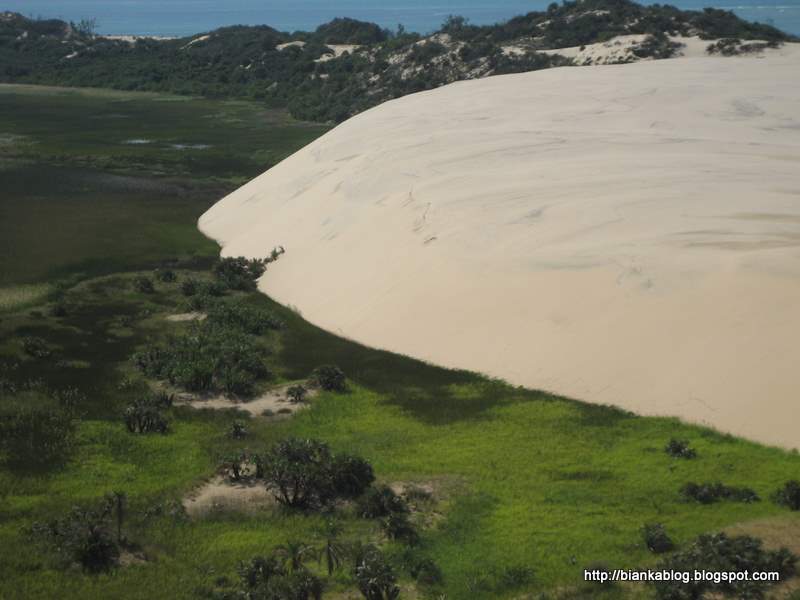
You will also find out a lot about how sand behaves. Like why the sand builds up behind the broken shell in the above photo and why only the white sand does so. Why grains of sand will move easily in underwater currents creating shoals that we sailors need to avoid but, mud will not. Sand can also travel overland quite easily too as shown in this photo I took on an island off the coast of Mozambique:  

THIS DUNE ON AN ISLAND OFF MOZAMBIQUE IS ABOUT 100 FEET HIGH

Even if you don't sail like I do but, spend  your time just sitting on a beach. Reading the book SAND you will find out about the eco system that resides in between those grains of sand on the beach you are walking on and not just those creatures you see are on top of it. 
I happen to think it is the perfect book to read on the beach too!

A billion sand grains are made every second and it's not going away anytime soon.  The book SAND by Michael Welland will give you new insight into a material you might have previously taken for granted. Still think sand is not interesting?  Take a look at this:
 
Markus Kayser - Solar Sinter Project from Markus Kayser on Vimeo.

Saturday, July 02, 2011

HEMINGWAY AND THE SEA


 “Age is my alarm clock,” the old man said. “Why do old men wake so early? Is it to have one longer day?”“I don’t know,” the boy said. “All I know is that young boys sleep late and hard.”
-OLD MAN AND THE SEA
 
 It was fifty years ago today that writer Ernest Hemingway known around Key West as Papa Hemingway took his own life in Ketchum Idaho.  A place far away from the sea and places like Key West where he wrote many of his novels. Novels like TO HAVE AND HAVE NOT . A novel that takes place in Key West during the depression. It was later made into a movie with Humphrey Bogart and Laureen Bacall. Mariners and the sea play an important role in some of his most famous writing. Like the OLD MAN AND THE SEA  published in 1952 and was the last novel published while he was alive. It was the tale of an old Cuban fisherman a little down on his luck having not caught a fish in over eighty plus days. He was viewed as such a "Jonah" that the parents of his young apprentice refused to let their son get on a boat with him. It too was made into a several movie versions staring Spencer Tracy and Anthony Quinn.
Another Hemingway novel that takes place on the water is ISLANDS IN THE STREAM was published almost ten years after his death.  This story takes place around the waters of Bimini in World War II. A movie was made from it with George C. Scott.  Hemingway certainly knew the sea having spent a lot of time on it fishing on his boat Land And Sea Collection "Hemingway's PILAR Sport Fish Finished Model" Collector quality and a reasonable pricePilar  which is still on display in Cuba. During WWII he also used it to patrol the waters around Cuba looking for German U boats and probably doing some fishing too no doubt. I wonder if he might not have taken his own life had he remained near the waters he enjoyed and spent so much time on and where he had been so productive in his writings.