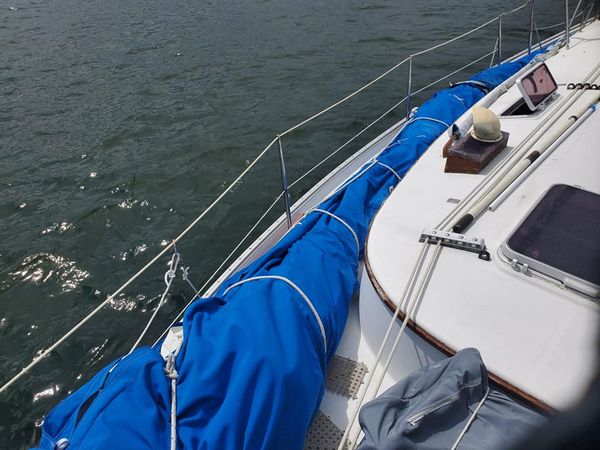
It's been almost 36 years since Long Island suffered a direct hit from a Hurricane. So I spent the the morning on BIANKA doing storm preparation as hurricane Henri approaches.
Added a second line to the mooring. Removed anchor from the bow roller to prevent it from cutting through the mooring lines.Finally dropped the sail and cover on deck to reduce windage. I took a photo as I headed for shore. Hope it's not the last photo I take of BIANKA. Now I can only hope for the best.
Showing posts with label BOAT PREP. Show all posts
Saturday, August 21, 2021
HURRICANE HENRI PREP
Labels:
BOAT PREP,
Henri,
HURRICANE,
LONG ISLAND,
Long Island Sound,
mooring,
sail,
storm prep
Monday, November 12, 2012
LESSONS LEARNED FROM HURRICANE SANDY
It's been almost two weeks since Hurricane Sandy came ashore and decimated parts of the northeast United States especially those living near the shore areas. I was pretty lucky despite finding BIANKA over a thousand feet away from where I left her the night before the storm I found her floating and still attached to her 300 pound mooring. Here are some of the lessons I learned from Sandy:
1) Putting an extra line on the mooring works well as a precaution to keep the boat attached to the mooring. I probably don't need to attach the anchor chain on board to the mooring chain as I did when Hurricane Irene threatened last year.

2) The surge from a storm is going to have a big impact on weather the boat stays put or decides to wander across the harbor. I may need to think about adding additional anchors to the mooring chain to try and keep it in place or close to it when the tidal surge comes in. This will involve some prep and diving before the storm hits. Perhaps a heavier mooring might be in order. Upon inspection earlier this year the eye of the mooring was showing quite a bit of wear following last years Hurricane Irene.
This yearBIANKA's mooring had a new eye welded on to it at the beginning of the season. I'll be interested to see what it looks like when it is pulled after Sandy.
3) I need to be more thorough in making sure I have dogged the hatches. I'm still amazed I missed latching the overhead hatch in the forward cabin. It was closed but, not secure.
The winds from Sandy were able to lift it and fling it wide open damaging the Charlie Noble vent for the water heater. Luckily there was not a lot of rain when Sandy hit the area and I only found about an inch of water in the bilge and a damp bed quilt.
4) The solar bimini with it's solar panelsI built over the cockpit is strong enough to stand up to hurricane force winds and there is no need to take it down before the storm. The design has now been through three hurricanes with Sandy's gusts to 95 MPH being the strongest so far. I do have to secure the clear Lexan centerpiece better as the two screws holding it to the frame were not enough to hold it in storm conditions but, that was just a temporary install at the time Sandy hit anyway.
5) I should have probably taken the sail down below. I did for Hurricane Irene last year. But, this time I opted not to do it. I was on the boat the day before Sandy and the winds were blowing 30 to 35 knots at times and the boat seemed to be riding well. So I opted to leave them on. Not sure how much of difference it would have made since BIANKA's beam is over 11 feet and there were plenty of other boats that dragged that had there sails stripped off of them. But, in the future I will store it below when another storm threatens.
6) I ran out of propane about two weeks before Sandy. Even though I was heading out on a fall cruise I opted not to refill the propane tank
since it was toward the end of the season. I thought I would refill it in the spring. I would use my backup cooking devices for the few remaining weeks. One of my backups is a butane single burner stove. I bought some additional butane canisters but, when I went to try it I found the butane did not flow to the burner. Some parts looked a little corroded and I did not think it safe to use it. I then went to my second backup which was a Coleman PefectFlow 1-Burner Stove
which works very well 


as a backup but, can only be used at an anchorage in calm conditions because cooking pots and pans are not secure from toppling over. Luckily, I bought some extra Propane Fuel Canisters
for it's use before Sandy hit. Because they might have been scarce after the storm knocked out power and some people on land would be using alternate cooking devices like I was. As it was I was on my last propane canister when power was restored back at home and was beginning to wonder if I would be able to find more if I needed them. So getting the on board propane tank refilled should be a priority if one wants to be able to move on board after a storm without worry.
7) Communications can get spotty after a storm like Sandy hit's. At first things seemed to be ok but, as the days wore on and the batteries and generators of the cell phone towers ran down communications began to get flaky. Cell phone calls dropped out, internet access via the cell phone modem was slow or non existent at times. It seemed that emails sent from my Blackberry were the most reliable form of communications when the others were not reliable.
8) Having an Engel Portable Refrigerator - Freezer
and a cooler on board was a great asset to have. I made the decision to move on board primarily because I had all my basic needs available there. Including refrigeration with the Engel . I was able to empty the freezer at home and store most of the frozen items in the Engel in freezer mode and use the Coleman cooler for the items that just needed to be refrigerated. So I threw very little of the food at home away and had plenty for a week of meals on board the boat without having to find a supermarket or grocery store. I took frozen items from the Engel and defrosted them in the Coleman cooler as needed where it helped to keep the cooler items cold too. As I emptied the Engel I froze plastic water bottles to use as the ice ran out in the cooler.
9) Since I was just getting back from a 200 mile fall cruise as Sandy approached I did not refill the gasoline jerry jugs I use for the Honda 2000 generator. I was winding down the sailing season so I had less than a gallon left of the six gallons I usually carry when cruising. Again since it was toward the end of the season I saw no need to refill them. But, after Sandy hit a lot of gas stations had no power for several days and then after power was restored there was a run on gasoline and they were soon shut because they no longer had gasoline. Even as I write this two weeks after the storm gasoline is being rationed by a system of odd and even license plate days. So the lesson learned when a storm threatens refill the jerry jugs before it hits. It turns out I did not need to run the Honda 2000 generator that much. I only ran it for a few hours one day out of the seven I was on board. But, if I had to use it more I might have run out of gas before too long. So the lesson is to keep your fuel supply topped up and ready until you are sure you won't need it. The same goes for the water tanks.
10) Having solar and a wind turbine on board is a real plus for after storm living. As I mentioned above I only had to run the Honda 2000 generator one day for a few hours. That was because we had a some cloudy days during and after Sandy and with the ENGEL running in freezer mode it was draw a few more amps than usual. But, after things got charged up I was able to use both the 12 volt house bank and the 10 kilowatt 48 volt propulsion bank efficiently. During the day when the sun was out I would power the Engel freezer from the 12 house bank as the two 75 solar panels were able to power it and charge the house bank a little. I used the 48 volt propulsion bank to power my laptop as I checked emails and blogged. In the evening after I was done using the computer I would then power the ENGEL freezer from the 48 volt bank because in addition to some solar I also had the Marine Air X 48 volt wind turbine helpeing to charge things overnight. I needed to use the 12 volt house bank to power some LED lights and a small radio.
In short I found that after a storm reeks havoc on land moving onto ones boat is better way to weather the aftermath until things get back to normal on land. Provided of course you already have the systems and provisions on board to live for an extended time at anchor which I did.
1) Putting an extra line on the mooring works well as a precaution to keep the boat attached to the mooring. I probably don't need to attach the anchor chain on board to the mooring chain as I did when Hurricane Irene threatened last year.
2) The surge from a storm is going to have a big impact on weather the boat stays put or decides to wander across the harbor. I may need to think about adding additional anchors to the mooring chain to try and keep it in place or close to it when the tidal surge comes in. This will involve some prep and diving before the storm hits. Perhaps a heavier mooring might be in order. Upon inspection earlier this year the eye of the mooring was showing quite a bit of wear following last years Hurricane Irene.
This yearBIANKA's mooring had a new eye welded on to it at the beginning of the season. I'll be interested to see what it looks like when it is pulled after Sandy.
3) I need to be more thorough in making sure I have dogged the hatches. I'm still amazed I missed latching the overhead hatch in the forward cabin. It was closed but, not secure.
The winds from Sandy were able to lift it and fling it wide open damaging the Charlie Noble vent for the water heater. Luckily there was not a lot of rain when Sandy hit the area and I only found about an inch of water in the bilge and a damp bed quilt.
4) The solar bimini with it's solar panelsI built over the cockpit is strong enough to stand up to hurricane force winds and there is no need to take it down before the storm. The design has now been through three hurricanes with Sandy's gusts to 95 MPH being the strongest so far. I do have to secure the clear Lexan centerpiece better as the two screws holding it to the frame were not enough to hold it in storm conditions but, that was just a temporary install at the time Sandy hit anyway.
5) I should have probably taken the sail down below. I did for Hurricane Irene last year. But, this time I opted not to do it. I was on the boat the day before Sandy and the winds were blowing 30 to 35 knots at times and the boat seemed to be riding well. So I opted to leave them on. Not sure how much of difference it would have made since BIANKA's beam is over 11 feet and there were plenty of other boats that dragged that had there sails stripped off of them. But, in the future I will store it below when another storm threatens.
6) I ran out of propane about two weeks before Sandy. Even though I was heading out on a fall cruise I opted not to refill the propane tank
as a backup but, can only be used at an anchorage in calm conditions because cooking pots and pans are not secure from toppling over. Luckily, I bought some extra Propane Fuel Canisters
7) Communications can get spotty after a storm like Sandy hit's. At first things seemed to be ok but, as the days wore on and the batteries and generators of the cell phone towers ran down communications began to get flaky. Cell phone calls dropped out, internet access via the cell phone modem was slow or non existent at times. It seemed that emails sent from my Blackberry were the most reliable form of communications when the others were not reliable.
8) Having an Engel Portable Refrigerator - Freezer
9) Since I was just getting back from a 200 mile fall cruise as Sandy approached I did not refill the gasoline jerry jugs I use for the Honda 2000 generator. I was winding down the sailing season so I had less than a gallon left of the six gallons I usually carry when cruising. Again since it was toward the end of the season I saw no need to refill them. But, after Sandy hit a lot of gas stations had no power for several days and then after power was restored there was a run on gasoline and they were soon shut because they no longer had gasoline. Even as I write this two weeks after the storm gasoline is being rationed by a system of odd and even license plate days. So the lesson learned when a storm threatens refill the jerry jugs before it hits. It turns out I did not need to run the Honda 2000 generator that much. I only ran it for a few hours one day out of the seven I was on board. But, if I had to use it more I might have run out of gas before too long. So the lesson is to keep your fuel supply topped up and ready until you are sure you won't need it. The same goes for the water tanks.
10) Having solar and a wind turbine on board is a real plus for after storm living. As I mentioned above I only had to run the Honda 2000 generator one day for a few hours. That was because we had a some cloudy days during and after Sandy and with the ENGEL running in freezer mode it was draw a few more amps than usual. But, after things got charged up I was able to use both the 12 volt house bank and the 10 kilowatt 48 volt propulsion bank efficiently. During the day when the sun was out I would power the Engel freezer from the 12 house bank as the two 75 solar panels were able to power it and charge the house bank a little. I used the 48 volt propulsion bank to power my laptop as I checked emails and blogged. In the evening after I was done using the computer I would then power the ENGEL freezer from the 48 volt bank because in addition to some solar I also had the Marine Air X 48 volt wind turbine helpeing to charge things overnight. I needed to use the 12 volt house bank to power some LED lights and a small radio.
In short I found that after a storm reeks havoc on land moving onto ones boat is better way to weather the aftermath until things get back to normal on land. Provided of course you already have the systems and provisions on board to live for an extended time at anchor which I did.
Tuesday, August 28, 2012
ONE YEAR AGO
One year ago I was in Washington D.C. two hundred and fifty miles from my boat as Hurricane Irene traveled up the coast and put BIANKA and the harbor where she was moored on the bad side of the storm. I had spent the previous two days taking off the sails and adding lines and chain to the mooring in the hopes that the boat would survive. I did all I could do and then boarded a train in New York and headed down to DC for a previously planned work gig. It was hard being so far away from the boat and not knowing how it fared. But, everything turned out OK in the end for BIANKA and most of the boats in the harbor. But, it can not be stressed too often that you need to prepare your boat for such storms as best you can and pay particular attention to try and make sure that lines don't chafe. The video below shows how fast your boat can be gone if you fail to tackle that all important chaffing issue.
Labels:
BOAT PREP,
Chafe,
HURRICANE,
HURRICANE IRENE,
storms
Wednesday, June 27, 2012
SPRING CLEANING: PROP AND DYNAPLATE
I don't put any anti fouling on my prop. I do occasionally dive over the summer and clean the prop by hand when the boat is in the water. But, late in the season the water gets a little too cold to do so. When I pull the boat there might be a few barnacles that have attached themselves to the prop. So one of my annual spring outfitting chores is cleaning and polishing the prop. I start using my trusty hand held Paint Scrapper
to knock off what barnacles I can:
It easy to knock off the hard barnacle shells using this tool both on land and also when the boat is in the water too.
Once I've removed most of the barnacles that attached to the prop late in the season. I then switch to using an electric drill and an 3M Paint and Rust Stripper
which makes cleaning and polishing the prop a fast and easy process as this video shows:
It also does a real good job cleaning and polishing the boats Dyna Plate ground plane too:
It easy to knock off the hard barnacle shells using this tool both on land and also when the boat is in the water too.
Once I've removed most of the barnacles that attached to the prop late in the season. I then switch to using an electric drill and an 3M Paint and Rust Stripper
It also does a real good job cleaning and polishing the boats Dyna Plate ground plane too:
Monday, June 04, 2012
HURRICANE SEASON 2012
We interrupt the Bahamas Exumas blog posts to remind you that the 2012 Atlantic Hurricane season has begun. The people in the Bahamas are reminded of this with every letter they send as the Bahamas stamp above shows. BIANKA has survived through two recent brushes with Hurricanes. Earl in 2010 and last year with Irene. Experiences I hope not to repeat. Irene was particularly disturbing because unfortunately I had to be 250 miles away on a work assignment and was not able to check on the boat during or after the storm. The best that I could do was prepare the boat and then hope for the best. Hurricane preparation for your boat especially when it comes to chafe protection of the lines that hold it should be a top priority as this video shows what kinds of conditions boats on moorings and anchor might go through:
Best to have a plan in place before a Hurricane threatens.
Thursday, September 15, 2011
BACK ON BOARD POST IRENE
What was unnerving for me as Hurricane Irene approached was the fact because of a work commitment I would be 250 miles away when the storm hit. Not only that, I would not be getting back to the boat for a least two weeks afterward. Happily, I got word fairly soon after the storm had past that BIANKA had survived. That was a relief knowing the boat was OK and my hurricane prep had worked. I tried a few things before I left the boat. Some ideas worked and some ideas need improvement. This is a picture of how I left things at BIANKA's bow before I left the boat:
You can see the anchor has been removed. Two lines the primary and backup are attached to the mooring and are free. Not easily seen is the anchor chain on the right roller that drops straight down below the surface of the water and is attached to the mooring chain at a different link than the lines above. I've already expressed my how I like to have cable ties on board for all sorts of handy reasons. Here I am using them to hold some split tubing in position as some anti chafe protection. Also note I am using the cable ties through the holes in the bow rollers. The plan being to prevent the mooring lines from jumping off the rollers during the storm. I'm using cable ties in the belief they would not chafe the lines like a metal screw would. The cable ties worked as planned or at least the mooring lines never jumped out of the bow rollers. Some of my other ideas not so good.
Returning back to BIANKA after two weeks I found this scene:
Thursday, September 01, 2011
AFTER THE STORM THOUGHTS OF AN ELECTRIC SAILOR
It was a relief that BIANKA made it through Hurricane Irene at the mooring. I had been on board during Hurricane Earl last year when it went to the east of the boat and felt more comfortable then because of the back up plans I had in place. When Irene hit much closer and to the west leaving BIANKA on the side with the stronger winds I was less sure of the outcome. Plus I was in a location that was much more crowded with other boats this time. But, now at least I know my plans seemed to work out for Category 1 storms like Irene.
Some post storm thoughts:
Besides the electronics I took off the boat, I also took a many of the electronics from my project box that had yet to be installed. I almost overlooked that aspect of hurricane prep. But, when I started to add up the costs of the unopened packages of the devices the number was in the hundreds of dollars. Not an insignificant amount.
I also took off my Honda 2000i generator and the five gallons of gas I had on board. The generator of course is an expensive item to be replaced. At 47 pounds it is lightweight enough to be easily taken off the boat. You can't say that for an installed diesel genset. But, I was also thinking if one is anchored in an exotic local and one went to ashore to ride out the storm rather than stay on board. Having a lightweight electric generator and a couple of gallons of gas would make one a very welcome guest in many households on shore.
Finally, while I was on board I thought about my electric propulsion system. If I had more time and if the storm was going to be stronger than projections I could have removed most of my electric propulsion system. The major components like the controller box and battery charger have removable connectors and the boxes are held on with a few bolts and nuts I could have easily removed them. Like wise the motor could have been removed and carried off the boat in a boat bag.
Which is how I bought it on board in the first place. You can't do that with a diesel. While I might have lost the boat in some circumstances. I would still have the basic components of my electric propulsion system intact and ready to be installed in a replacement boat. Though I am glad things never came to that.
Some post storm thoughts:
Besides the electronics I took off the boat, I also took a many of the electronics from my project box that had yet to be installed. I almost overlooked that aspect of hurricane prep. But, when I started to add up the costs of the unopened packages of the devices the number was in the hundreds of dollars. Not an insignificant amount.
I also took off my Honda 2000i generator and the five gallons of gas I had on board. The generator of course is an expensive item to be replaced. At 47 pounds it is lightweight enough to be easily taken off the boat. You can't say that for an installed diesel genset. But, I was also thinking if one is anchored in an exotic local and one went to ashore to ride out the storm rather than stay on board. Having a lightweight electric generator and a couple of gallons of gas would make one a very welcome guest in many households on shore.
Finally, while I was on board I thought about my electric propulsion system. If I had more time and if the storm was going to be stronger than projections I could have removed most of my electric propulsion system. The major components like the controller box and battery charger have removable connectors and the boxes are held on with a few bolts and nuts I could have easily removed them. Like wise the motor could have been removed and carried off the boat in a boat bag.
Which is how I bought it on board in the first place. You can't do that with a diesel. While I might have lost the boat in some circumstances. I would still have the basic components of my electric propulsion system intact and ready to be installed in a replacement boat. Though I am glad things never came to that.
Labels:
BOAT PREP,
electric propulsion,
HURRICANE,
HURRICANE IRENE,
storms
Saturday, August 27, 2011
THE CALM BEFORE THE STORM
Spent most of yesterday on board. It was a beautiful cloudless windless day. A fine summer day in August. It would be hard to predict what was coming from these conditions. It was a tad humid and hot and as a result I took a few swims in between prepping the boat for the arrival of Hurricane Irene. I got a email from Bob who writes the BOAT BITS blog and who recently had some sundowners on board his boat while the eye of the same Irene passed over St. Criox a few days ago. He mentioned that Jeff Masters at Weather Underground said the eye wall of Irene was weakening. Meaning that the storm was not strengthening. That good news was tempered with my talk with the guys at the boatyard who said that during Hurricane Gloria the last storm to directly hit the Isle of Long there were 100 boats on the beach. I'm trying to make sure that BIANKA is not going to be one of them after this storm.
There were a number of owners out preparing their boats but, not everyone. Some were just wrapping their sails up. While others like myself and those on the moorings around me where taking them off completely.
Funny how an approaching storm can get one to focus on those little projects that one has not gotten to on board. Like replacing the temporary cable tie that was holding up one of the solar bimini frames.
I had the eye strap on board for over a week and did not get around to installing it. Irene got me focused on making sure it was installed. Cable ties
are useful things on a boat. But, trusting them to hold up in Hurricane conditions is asking too much from them.
I also secured some of the wiring for the solar panels that was on my to do list too.
While on board I decided to do add some additional attachment to the mooring beyond the primary and secondary mooring line. I was worried about my Bruce anchor which hangs over the bowsprit could catch on an errant boats life lines or pushpit and could drag BIANKA along with it or cause a lot of damage. So I removed the anchor and stowed it below. I then used the anchor chain to act as a the "all hell breaks loose" third pennant to the mooring chain. I shackled it to a different link than the line pennants with a shackle and a swivel. It's always good to have a number of shackles of various sizes on board.
They may cost a few sheckles but, in situations like this they are priceless! I'm also glad I took the time last year during Hurricane Earl to use some Tef Gel on the shackle threads. This made them able to unscrew easily when I needed them. I also wrapped and secured the chain around the mast. This made sure that the Sampson Post was not the only point on the bow recieving the stress from the storm pull. I feel with the anchor chain now secured to the mooring system BIANKA my drag onto the beach but, it will be taking it's mooring with it. I added some anti chaffing to the existing lines and adjusted the anti sail bow drogue I used last year while riding out Hurricane Earl in three Mile Harbor. I stayed on board until about 10:30 pm exhausted and tired having done everything I could think of to make sure BIANKA would still be floating come Monday. Now I only have to watch and wait for the storm to arrive.
There were a number of owners out preparing their boats but, not everyone. Some were just wrapping their sails up. While others like myself and those on the moorings around me where taking them off completely.
Funny how an approaching storm can get one to focus on those little projects that one has not gotten to on board. Like replacing the temporary cable tie that was holding up one of the solar bimini frames.
I had the eye strap on board for over a week and did not get around to installing it. Irene got me focused on making sure it was installed. Cable ties
I also secured some of the wiring for the solar panels that was on my to do list too.
While on board I decided to do add some additional attachment to the mooring beyond the primary and secondary mooring line. I was worried about my Bruce anchor which hangs over the bowsprit could catch on an errant boats life lines or pushpit and could drag BIANKA along with it or cause a lot of damage. So I removed the anchor and stowed it below. I then used the anchor chain to act as a the "all hell breaks loose" third pennant to the mooring chain. I shackled it to a different link than the line pennants with a shackle and a swivel. It's always good to have a number of shackles of various sizes on board.
They may cost a few sheckles but, in situations like this they are priceless! I'm also glad I took the time last year during Hurricane Earl to use some Tef Gel on the shackle threads. This made them able to unscrew easily when I needed them. I also wrapped and secured the chain around the mast. This made sure that the Sampson Post was not the only point on the bow recieving the stress from the storm pull. I feel with the anchor chain now secured to the mooring system BIANKA my drag onto the beach but, it will be taking it's mooring with it. I added some anti chaffing to the existing lines and adjusted the anti sail bow drogue I used last year while riding out Hurricane Earl in three Mile Harbor. I stayed on board until about 10:30 pm exhausted and tired having done everything I could think of to make sure BIANKA would still be floating come Monday. Now I only have to watch and wait for the storm to arrive.
Labels:
anchor,
BOAT PREP,
chain,
HURRICANE,
HURRICANE IRENE,
LONG ISLAND,
Long Island Sound,
storms
Friday, August 26, 2011
AND SUCKIER!
Not good to to wake up to this:
"DANGEROUS HURRICANE IRENE TO IMPACT THE REGION SATURDAY NIGHT INTO SUNDAY NIGHT..."
Looks like a direct hit right over the boat. One final visit today to take the sail down add anti-chaffing gear. Just hope it won't be the final visit.
"DANGEROUS HURRICANE IRENE TO IMPACT THE REGION SATURDAY NIGHT INTO SUNDAY NIGHT..."
Looks like a direct hit right over the boat. One final visit today to take the sail down add anti-chaffing gear. Just hope it won't be the final visit.
Labels:
BOAT PREP,
HURRICANE,
HURRICANE IRENE,
HURRICANE PREDICTIONS,
storms
Thursday, August 25, 2011
AND IT GET'S SUCKIER!
This latest track shows Irene moving a little toward the west putting most of the Isle of Long and my location on the nastier side of the storm. Spent this morning adding an additional line to the mooring. I'll be back on board tomorrow to finish up. I took some tools off the boat and some electronics. I'm also facing the reality there is a chance I may lose the boat with this storm. When I rode out Hurricane Earl last year at anchor I was more confident in the situation. I had plan A, B, C & D ready. But, back on the mooring I only have one shot with plan A. Even if that works there are hundreds of other boats in the harbor whose owners may have no plan at all. Which could make all my plans moot if they drag into the BIANKA. I am optimistic but, also resigned that nature also has it's plan A.
Labels:
BOAT PREP,
HURRICANE,
HURRICANE IRENE,
HURRICANE PREDICTIONS,
LONG ISLAND,
storms
Saturday, June 04, 2011
WHAT WORKS: 3M PAINT AND RUST STRIPPER
BIANKA is about to be splashed so I'm busy putting the finishing things that need to be done below the waterline. There are not too many things to do beyond fresh zincs and checking to make sure the through hulls are clear. One thing that needs to be done is to clean the prop and ground plate of whatever growth still remains. I use to spend a lot of time with a hand scrapper accomplishing this task. Then I discovered that a 3M 7772ES Paint and Rust Stripper
and an electric drill makes this task so much easier and faster.
Here is the before photo of the prop:

can make shiny and new. It also does a great job on on the boats Dyna Plate grounding bar making it really shine:
My biggest concern here is that some landlubber yahoo wandering through the boatyard is going to think it is a gold bar instead of bronze and try to steal it off the boat. So it's best to get the boat in the water as soon as possible.
Here is the before photo of the prop:
There are few pesky barnacles and some hard sponge like growth. Below is what one of the blades looks like with less than a minutes worth of work using the 3M Paint and Rust Stripper
and my trusty Black and Decker Drill:
In five minutes you can have the prop nice and shiny and ready for the water. It might also uncover some important information about your boats prop as I did:
The above shows I have a 16 inch right hand turning prop with a 13 inch pitch. Important info if one wants to change or replace a prop. Props are not the only thing the 3M Paint and Rust Stripper My biggest concern here is that some landlubber yahoo wandering through the boatyard is going to think it is a gold bar instead of bronze and try to steal it off the boat. So it's best to get the boat in the water as soon as possible.
Subscribe to:
Posts (Atom)