Showing posts with label power. Show all posts

Saturday, June 11, 2016

UH OH!: A BATTERY ANOMALY

Just when I thought I was ready to splash BIANKA for the season I made a disturbing discovery concerning one of the batteries in the 48 volt propulsion bank. The Dual Pro PS4 battery charger showed battery number four with a blinking green light where as all the others were steady after having been charged.  This was a new development as for the past several weeks all the batteries had been charging normally on my visits. For some reason the charger thinks battery four is not yet fully charged. I disconnected the power from the charger to let the batteries sit overnight and make sure it would not fire up when I plugged the extension cord  back on my return in the morning.

The next morning I went into the cockpit and threw the switch on the helm instrumentation panel that powers the individual battery meters. My suspicions were confirmed. Battery four is not being charged properly:

As you can see the bottom meter which is reading battery four is only 11.1 volts where the other three batteries are much closer to each other in voltage. So it looks like I will have to forget about launching the boat until I can investigate what it is going on with this battery. TO BE CONTINUED.

Tuesday, May 12, 2015

CONVENIENCE WIRING WITH ANDERSON POWER POLE CONNECTORS AND A RIGRUNNER JUNCTION BOX

I mentioned in a previous post about using my Morningstar solar controller as a junction point for some new rewiring rather than the main breaker panel. I also added a  Rigrunner 4005 junction box. This box allows for several individually fused  Anderson Power Pole connectors to be plugged into the box.


 You can see some of the items I chose to connect to the box in the photo below:

Monday, January 06, 2014

NOTES OF AN ELECTRIC SAILOR: The AIMS 48 Volt 1500 Watt Pure Sine Wave Inverter

After I bought the Electric Paddle outboard some things went away. Such as the need to carry extra oil, gas and parts like zincs, spark plugs etc... for the Honda BF2 outboard.  But, I was faced with another issue on how to charge the Electric Paddle's battery. BIANKA usually stays on a mooring or at anchor so charging from the dock power is not an option.  Since part of my three legged approach to energy on board BIANKA includes a Honda 2000 generator charging the 28 volt battery is a easy but, I really don't like to run the generator if I can avoid it. Running it for an hour or two to just charge the Electric Paddle's battery just seems like a waste of energy. So I started thinking about getting an inverter for the boat. According to the Electric Paddle's manual the 120 volt charger can charge the battery using an inverter of only 200 watts. Though when I thought about it there might be a few other 120 volt items I might like to use on board from time to time without needing to fire up the Honda Generator. Having a 10 kilowatt 48 volt electric propulsion battery


bank does come in handy after it is charged up at anchor. One can easily tap into it from time to time and then  just let the solar panels and wind generator recharge things without ever having to fire up the generator. So it seemed like it was a good idea to spring for a 48 volt to 120 volt sine wave inverter to not only charge the Electric Paddle battery but, also be able to use it for other needs like running the Wet/Dry Micro Vac for quick clean ups, using 120 power tools and maybe a bread maker or microwave down the road. The inverter I decided on was the AIMS PWRI150048S 1500 Watt Pure Sine Wave Power Inverter, 48 Volt. It would easily be able to handle charging the Electric Paddle battery pack and also be powerful enough to use for more powerful AC items.

When I first bought the Thoosa 9000 electric propulsion system for the boat I also purchased a 48 volt to 12 volt converter. It is a 300 watt Sevcon converter. I mostly use it for powering the laptop while at anchor to blog and search the Internet. It works well with the 12 volt power supply I bought for the computer. I've also used it to temporarily power the on board Engel Refrigerator - Freezer when several days of cloudy/rainy weather drained the 12 volt house bank to far. Here is are some photo's comparing the size of the converter and the inverter:


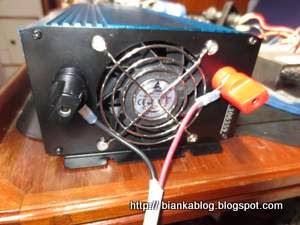
There is a bit of size difference but, the Inverter is five times as powerful and can be used to power more things including the laptop and Engel along with a number of 120 volt devices. Connection of the AIMS Inverter to the 48 volt battery bank is by two terminals on the back of the unit:

The front of the unit has two AC outlets, an on/off switch and two status LED's and a ground lug:


The AIMS Inverter also comes with a handy keychain type rf remote switch so you can mount the unit in a remote location on board but, still turn it on and off when needed without having access to the front panel on/off switch.  For now I have mounted the unit in the main cabin where I can see the status lights and have access to the on/off switch and AC outlets. I am also using the 15 amp tap of the 48 volt Morningstar solar controller to provide power for the inverter via 75 amp Anderson Powerpole connectors:

This means I am limited to only using around 700 watts of the 1500 watt potential on the inverter. But, for now that's all I need. So far the AIMS Inverter has come in very useful primarily for charging the Electric Paddle battery without requiring I run the generator for hours and it will come in even more useful to power other devices in the future.


Saturday, November 27, 2010

GENERATING UNDERWAY

I was finally able to get some regenerated power under sail from BINAKA's electric propulsion system this past season. That is where the electric motor that propels BIANKA is also used to as a generator under sail to recharge the battery bank. I still need to tweak a a few things which I think will improve preformance. But, it does work. Those who still have a diesel engine on board can achieve the same effect using a towed prop and generator. 


A good  tutorial on the setup and real world experience is found here on the boat Whoosh.

Wednesday, October 13, 2010

REPORT FROM ANNAPOLIS: PART 3: GENERATING INTEREST

As I wandered around the boat show I was surprised to see the number of booths that were selling various model Honda Generators.


I use a Honda 2000EUi generator on board BIANKA. It is a real work horse especially on my boat with it's electric propulsion auxilary. I use it for charging the 48 volt and 12 volt battery banks, powering 120 volt tools, and it can also provide about 3 knots of electric propulsion when needed without taking any amps from the 48 volt battery bank.  Mine is a standard off the shelf model standard AC jacks. But, I did see a new version (at least for me) that makes sense for carrying on board.

It is a Honda 2000 with a 30 amp marine AC jack. This is handy because you can just plug in your boats marine AC cable directly into the generator just like you would hook up at a dock. It is more weather proof than the standard outlets and means you don't have to add an extra adapter into the power mix. If you are looking to buy a Honda generator for onboard use this might be the way to go.

Sunday, October 04, 2009

WHAT WORKS ON BOARD: Powerstar DC Converter

Before I bought BIANKA I had a 24 foot Bristol. A fine boat of which I still have fond memories cruising with. When I bought BIANKA there were not many things I took from the Bristol. One of the things I did take was this:

A Powerstar DC converter. It plugged into the single 12 volt cigarette lighter jack on board the Bristol and put out 120 volts on it's AC jack. It was a simple device you plugged it in to the 12 volt socket and a red light came on the showed the 120 volt outlet had voltage on it and you plugged in whatever AC device you wanted to use as long as it was rated 200 watts or lower and not too fussy about pure sine waves.

The reason I bought it was to power my new 1986 Toshiba 1100+ laptop.


It had two three and a half inch disk drives used MS-DOS and had NO hard drive and a monochrome LCD screen to boot. And to think it only cost about $1500 dollars in 1986!. Real whiz bang technology at the time. I try not to think to much that my current computer. You know the one with all the USB ports, Hundreds of giga bites hard drive and DVD burner only cost about a third of what I paid for that Toshiba. Of course the Toshiba still works but, like the other seven or eight computers I have bought in my lifetime it is never used today.
But, the DC converter still functions on board BIANKA. It can not be used to power my new laptop because the AC voltage put out by the Powerstar converter is a rather crude approximation of a pure AC sine wave and will fry most modern switching power supplies used in electronic devices. But, the Powerstar will power a Braun hand blender with no problems. So that means yummy Banana pancakes for breakfast as well as other treats from the galley. It has also come in useful many times to power things like the Dremel tool which is used for many projects on board. It's one of the things that really works on board. Even twenty years plus years after I bought it.