Showing posts with label water system. Show all posts

Monday, June 16, 2014

ANOTHER AHA MOMENT IN THE GALLEY

After removing the Paloma hot water heater and reconnecting the pressure water hoses I began thinking. The hoses I reconnected are in a real good location right in the galley and over the sink.

Then I had the AHA moment that it would be nice to have a spray nozzle at that location to help with washing the dishes. Since the hoses were already in that location it should be a simple matter to connect a spray nozzle. So I went out and bought a kitchen SPRAY REPLACEMENT ASSEMBLY; and also a 1/2 inch T adapter which I inserted


I also bought an adapter so I could connect the spray nozzle hose into the boats 1/2 inch pressure water hose.

 I took a few turns around the threads with teflon tape and inserted into a short piece of 1/2" hose:

I then took a 1/2" T connector and placed it between the former intake and hot water out hoses where the former water heater was and connected up the Spray Nozzle hose to it too:

With the hoses connected back up and the new Spray Nozzle connected:

I did a quick test and it worked perfectly. The spray nozzle will really help when cleaning dishes in the sink. Now all I have to do is add some hose clamps and secure the hoses and the job was complete:


Sunday, October 17, 2010

SEASONAL SIGNALS TO WINTERIZE THE BOAT

The storm and winds that prevented me from heading to the Oyster Festival were followed by the first reports of snow in the Adirondack Mountains. The Nor'easters can't be far behind. Here in the Northeast and other northern waters those are the seasonal signals it's time to start thinking about winterizing the boat. So this might be a good time to to review Capt. Mike's technique for winterizing BIANKA's water system using one gallon of antifreeze. 


One of the real nice things about having an electric propulsion system and no diesel on board is that winterizing the water system is about all that needs to be done to get BIANKA ready for winter.  Click here to see how Capt. Mike winterizes with just one gallon of antifreeze on board BIANKA.


TIP FROM CAPT MIKE: I test the recovered antifreeze using a refractometer to make sure the antifreeze will provide the needed freeze protection of the water system. If you get one that tests for both Propylene glycol (the kind used for winterizing the water system) and Ethylene glycol antifreeze (used in engines) you can also use it to check the engine antifreeze protection as well.

Thursday, April 15, 2010

WATER WATER EVERYWHERE!

One of the nice things about having the world's first electrically propelled Nonsuch 30 is I no longer need to find or tie up at a fuel dock. This is a real good thing. Unfortunately, I still occasionally need to stop at a dock to top off the water tanks. Bob at BOAT BITS has come across a promising technology that may soon eliminate the need for sailors to even make diversions and stops to find a dock with water.

How does it work?
Each individual device would only process minute amounts of water, but a large number of them — the researchers envision an array with 1,600 units fabricated on an 8-inch-diameter wafer — could produce about 15 liters of water per hour, enough to provide drinking water for several people. The whole unit could be self-contained and driven by gravity — salt water would be poured in at the top, and fresh water and concentrated brine collected from two outlets at the bottom.

They've already tested it in nearby local waters:
So far, the researchers have successfully tested a single unit, using seawater they collected from a Massachusetts beach. The water was then deliberately contaminated with small plastic particles, protein and human blood. The unit removed more than 99 percent of the salt and other contaminants. “We clearly demonstrated that we can do it at the unit chip level,”

This technology certainly sounds promising not only for us sailors who want spend as little time looking for a place to find water but, for many other people in the world who need clean drinking water.

Monday, November 30, 2009

WINTERIZING AND TESTING THE ANTIFREEZE ON BOARD

I've mentioned one of the nice things about converting BIANKA to electric propulsion is those recurring pleasant reminders of cost savings of going electric. This shows up most dramatically at the end of the season when it comes time to winterize the boat. Not having to change oil, filters and buy gallons of antifreeze to winterize the engine certainly something that I do not miss doing nor does my wallet. The only thing I really need to do is winterize the fresh water system and as I pointed out in this post on winterizing BIANKA I only need to use a small amount of propylene glycol antifreeze to do that. Though if you still have a diesel to winterize you might want to take a look at Maine Sails sage advice on that issue. I'm only dealing with the on board water system here.

While I have not had a problem with winterizing using this method I did have an online discussions with some other sailors about checking to make sure that the after winterizing that the antifreeze was not diluted to the point of being ineffective at the temperatures in my location. Not a bad idea I thought. Some use chemically treated slips of paper that change color to match the level of protection the antifreeze solution is providing. Others use the floating ball gauges and others use an optical hand refractometer.

So I began researching the testing methods. The antifreeze test strips were reasonably cheap around ten bucks for 50 strips. But, then I read they were only reliable for about two years. This might make sense for a boatyard that winterizes a lot of boats but, not for me. They could also give erroneous readings if contaminated. The next device was the floating ball antifreeze testers. Reasonable in price perhaps only ballpark in accuracy.

The third option was the hand refractometer. The most accurate in my opinion but, also the most expensive. In my initial research I saw prices of $120 to $220. Way to expensive to make sense for my wallet.
 But, found other antifreeze refractometers for around fifty bucks. Now that's more like it. Even better it has scales for propylene glycol, ethylene glycol and one for checking the charge on flooded lead acid batteries. That's a win, win, win situation in my book so I bought it.


The above photo shows the unit I bought. It comes with two eyedroppers. The one shown here has the blue tape around it to remind me that I only use it to sample distilled water. The little black cap covers the alignment screw should one need to realign the gauge. It also includes the screwdriver in the case. The photo below shows the plastic cover in the open position.

To use this device you open the cover and put a a drop or two of the solution you are testing onto the blueish glass and close the plastic cover to spread the solution onto the glass. You then hold the refractometer up to a lighted area and take a reading by looking into the eyepiece. Here is what you see when you look into the refractometer with no liquid on the glass.
You have a completely blue field. You can see the three different scales for the propylene glycol antifreeze, battery fluid and ethylene glycol antifreeze. When you open the unit up and drop a few drops of distilled water onto the reading glass this is similar to what you will see when you do a reading:


Notice how it is clear at around 32 degrees F scale. This is how you check the alignment of the device. Note: The photo shows a slightly lower freezing point which may be due to some slight contamination from an earlier test. Cleaning the glass or adjust the alignment screw would correct his offset. But you get the idea. Next the cover was opened the glass cleaned and dried and a drop or two of propylene glycol antifreeze taken from BIANKA's winterized water system was analyzed as shown below:

This shows a freezing point of about 15 degrees Fahrenheit on the propelyne gycol scale. Only 3 degrees "warmer" than the pure antifreeze used to winterize the system. The bursting point for pvc piping according to the manufacturer of the antifreeze should be about - 7 degrees Fahrenheit. Which is "comfortably" below the normal lowest winter temperatures in my area. As they say your mileage may vary or location temperatures may be different. But, using a refractometer to test the antifreeze used to winterize the on board water system will give you peace of mind as you wait for spring to return. Just remember:

"How sad would be November if we had no knowledge of the spring!"- Edwin Way Teale

Posted by Picasa

Friday, November 21, 2008

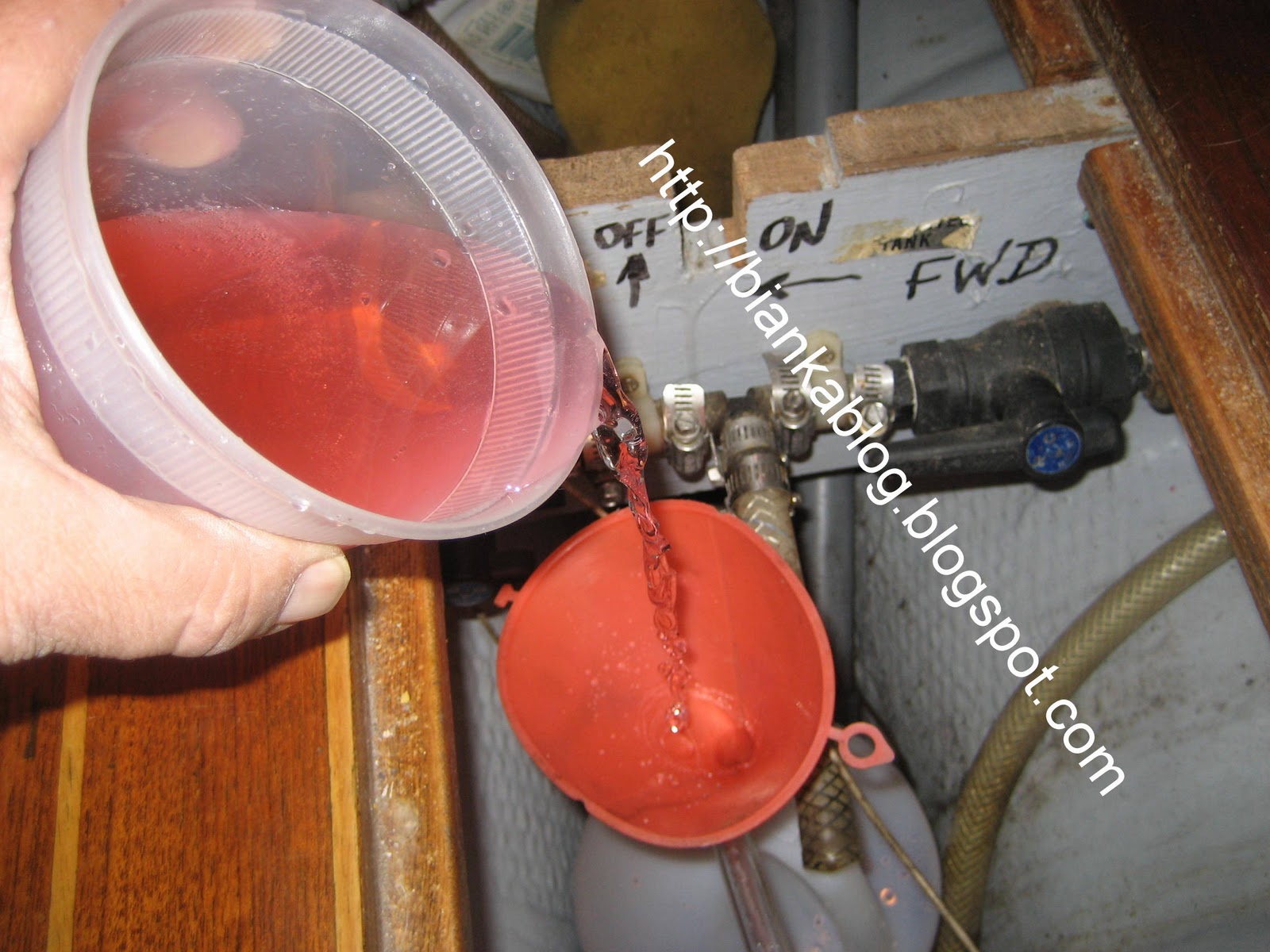
Winterizing a boat with one gallon of antifreeze

I wandered into the West Marine store to pick up some Starboard to use for making a permanent mount for the Thoosa electric motor throttle control and some propylene glycol antifreeze to winterize the boat. I got a little "sticker shock" from the price of the Propylene glycol antifreeze that is used to winterize on board water and engine systems. Almost five dollars a gallon! When I saw that I was glad I had converted to electric propulsion as I no longer need the extra three or four gallons to winterize the diesel engine. Knowing I had some left over Propylene glycol antifreeze from last year I opted to buy only one gallon. It turns out that is all I needed. This is good, very good. Good for the environment and good for the wallet.
Here is how I did it: