Showing posts with label tools. Show all posts

Monday, May 28, 2018

TYING THINGS UP!

 I got back on the boat the other day to get things ready for launching. I'm in no hurry this year as the spring has been rather wet and cold. Just messing about on the boat is nice since I have a harbor view from the boats location in the boat yard. So when NOAA said the day would be sunny and hot it seemed like a good idea to get down to BIANKA and start doing what needs to be done. When I got down to the boat it was indeed a hot day. Too hot to work in cabin much less down below the cockpit.
What to do except open a cold can of seltzer in the cockpit where there was a hint of a breeze and a little cooler. So some work around the cockpit seemed like the thing to do.
Looking around I noticed some of the wires around BIANKA's helm station looked like they could be tidied up.

They were out of the way enough but. making them a little neater and secure would not hurt. So I took out the newly bought Cable Tie Gun and went to work.

Once those were taken care of I remembered I needed to re secure the Helm Station platforms themselves as the old ty wraps holding them level had broken.  


Using the Tie Wrap Gun I had them re secured, tightened  and level in a few minutes. 


I think I should add a second ty wrap to add some extra holding power in the future. But, for now one should do. Then looking above my head I noticed that the wires for BIANKA's 48 volt solar panels needed to be secured. A few tie wraps slipped between aluminum bars and the job was done


It was a quick and easy job. But, one that helped make things neater and secure. Plus it made me feel somewhat productive on such a hot day.                  

Tuesday, April 05, 2016

TOOLS: POWER8 WORKSHOP

Here's an item that would fit right in on a cruising boat or even a landlubbers apartment:
 It's called the Power 8 Workshop:


It looks like it has just about every tool one might need to do a lot of different projects on board yet stores in a very compact space. Which is an important since space is always a concern.

  • Includes 4 Power Tools; variable speed hammer drill, circular saw, jigsaw and flashlight. Each tool integrates with the workbench to become a drill press, table saw, scroll saw and table light

Saturday, November 28, 2015

ONE LAST THING: Cleaning the Porta Boat

I finally broke down and splurged on renting a spot on the dingy dock for my eight foot Porta Boat. I spend most of my time during the summer living on the boat with an occasional respite on land for work or to accompany my gal on a beach vacation. Since I have been using a folding Porta Boat for fourteen years I was able to fold it up when and take it home as needed. As I'm getting older this is becoming more of a pain and so I opened the wallet to have access to the dingy dock at the boatyard. It certainly makes it more convenient for quick trips home or provisions. Since for over a decade I have avoided the dingy dock fees that could have paid for the Porta Boat three or four times over I thought it was about time to make things a little easier for me. Though leaving the Porta Boat in the water for the entire season bought some new issues.

Saturday, October 17, 2015

A QUICK STORAGE PROJECT

The three days hunkering down below waiting for the Nor' Easter to pass gave me time to work on some projects that have been on the "To Do"  list. I have three aerosol products that I try to keep handy in the tool locker. They are Corrosion Block, Boeshield T-9 and PB Blaster.  I often have to rummage through other items to get to them. Somewhat of a pain when all I need to do is grab one of them for a quick spray. So I came up with an idea of hanging a fabric pocket made out of some knock off Sunbrella material I had on board and hanging it on the inside of the tool locker door to hold the cans. It was a quick job using my Sailrite LSZ-1 Sewing Machine to put it together:
:


This allows for much easier access to them and utilizes the space inside the tool locker  much better. Not to mention less aggravation trying to find the cans among the other stored items

.

Saturday, June 13, 2015

USEFUL THINGS ON BOARD: PORTABLE WORK TABLE

While I was getting things ready for launching this spring I came across an old cutting board stored away at home. I thought it might be useful on board so I came up with an idea to make it useful as a portable work table. Using some scrap wood from an old bed frame and a couple of screws I soon had a very useful surface to work on around the boat. One place where I could use a work table space is in the aft quarter. Perhaps using the stainless steel pushpit railing for a support. I then thought how I could secure the cutting board from slipping off the rail. That's when I found the old wooden bed frame that already had a strip of wood running along an edge that would be perfect for the function:

After securing it to the cutting board with a few screws it was ready for a test fitting:


Perfect. The wooden lip will prevent the surface from sliding off the rail. I will probably install another strip so the rail fits between the two strips at some point but, this is fine for a start. I then took another piece of the old bed frame and screwed it into a position where it would sit on the cockpit coaming while the other board was sitting on the stern rail:


It tilts down at a slight angle but, not too bad.


While most items would not roll off the work table at this angle having a flat surface would be better. So looking around while putting on my "use what you got hat" I found that two 12 oz aluminum cans sitting on the coaming surface make for a perfectly level work surface:


Problem solved!  I also found another area where this portable work surface comes in very useful. I spent some time varnish the fold down cockpit table on BIANKA. I would prefer not to have to do this too often. I found my new portable cutting board work table fits nicely on top of the fold down table top while protecting the varnish job. It also  provides a handy work table service for projects at the same time:


Plus turning the work surface sideways allows for an even more secure work surface thanks to those edge strips:


I think this portable work table is going to come in very useful on board for a number of projects in various spots around the boat. I will continue to report the new uses for it as they appear.

Saturday, June 06, 2015

USEFUL TOOLS: PAINTERS POINTS

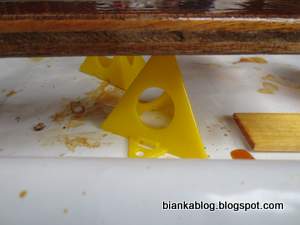
Because of the cold water temperatures I've been putting off the launching of BIANKA this year. So I've been doing a lot of maintenance items like varnishing and touching up some of the wood trim on board. Much easier when the boat is on solid ground anyway. Because one normally can only put varnish or paint on one side of an item it takes two days to do both sides of say a wood trimmed screen hatch. But, one can also speed things up and do a coat a day if one uses Painters Points.


These neat little plastic pieces allow you to not only raise an item you need to paint off the surface so you can paint all the way to the bottom without it sticking to what's underneath it.  But, you can also do one side a flat piece and then using the points to support the piece put a coat on the other side of the item. This allows you to put a coat on the whole piece in one day. The Painters Points can hold up to 200 lbs. I don't have anything nearly that heavy that I will be varnishing on board. But, even the small items I do have to maintain are done much faster without waiting an extra day for one side to dry. They also stack nicely for storage and don't take up a lot of room when not in use. Which is important on a boat. They came in very useful in varnishing the forward overhead screen hatch:


The points can be arranged to best support the item you are painting or varnishing:


I also used them when putting fresh coats of Cetolon the boarding ladder steps:


In short if you do a lot of refinishing on board these Painters Points come in very handy and can help speed up your projects.
         .

Saturday, March 14, 2015

FROM THE USE WHAT YOU GOT FILE: MELTING THE ICE

Last season I bought an Angle Clamp that I planned to use to repair some joinery on board. The winter did not allow for any work on board. Though a blizzard blew enough snow through the cockpit hatches to fill the bilge with ice:

When the temperature finally reached the mid 50 degree range I was hoping that some of this ice would have melted a bit so I could start to remove it. Unfortunately, it was still a pretty solid block of ice, I took out the heat gun and tried to start melting  some of it. It did start to melt but, holding the heat gun for any length of time was tiring. So I looked around to see if I could use something that would hold the heat gun while I used a wet dry vac to start removing the melted water. The Angle Clamp looked promising:


I clamped the handle of the Heat Gun in the clamp and laid the clamp across the bilge opening. It worked somewhat but the heat gun drooped and was not directed onto the top of the ice. Since the heat gun can cause damage to wood and fiberglass if the heat is directly applied to them I needed to make sure  I could direct the heat to the areas where the ice was prevalent.  Looking around I saw one of the fiberglass fishing wire poles I use to occasionally fish electrical wires on board. I placed it across the bilge opening and under the handle of the heat gun. It allowed me to perfectly direct the heat onto the top of the ice while removed the melting water:

It worked great. I managed to remove about twelve gallons of the melted ice water over the course of a few hours. ONE NOTE OF CAUTION: I would not leave the heat gun on while unattended and also make sure keep it away from any combustible parts of the boats structure. 

Saturday, December 27, 2014

MAKING YOUR OWN PARTS WHILE CRUISING?

   
While cruising this past year I met a family with a son in high school who had a 3D Printer at home. He made a new sheave for one of the blocks on their boat. While it was not really UV stabilized and it probably would not last as long as the original still, was holding up quite well after year. Pretty impressive. Making ones own small parts to replace broken ones while cruising might be common place at some point in the future if one had a 3D printer on board. I forgot which one he had but, I do notice even major tool companies like Dremel now have products like a Dremel Idea Builder 3D Printer for sale. The ability to make ones own custom parts even if only for a temporarily fix can save a cruise or enhance things on board. While current 3D printers may be somewhat large to carry on board some boats. There is another aspect of 3D printing may show up on land in the near future.  Hardware and marine stores with sophisticated 3D printer will be able to make parts using various materials that are currently unavailable. Even in remote locations. That would also be good thing for cruising sailors.


Saturday, August 23, 2014

TOOLS OF AN ELECTRIC SAILOR: Hopkins Measuring Funnel

One of the real nice things about Electric Propulsion and having removed the diesel engine from the boat is not needing to do multi quart oil changes every fifty hours. Indeed my maintenance has just about gone to zero in the seven years since I switched to electric propulsion. The only regular maintenance I have had to do has involved the Honda 2000 generator that serves for providing power for battery charging at anchor and also acts as a poor man's hybrid when doing an extended electro sail. The maintenance on the generator has  been minimal consisting mainly of an annual oil change. The oil change on the Honda 2000 does not
involve a lot of oil compared to the old Westebeke 27 diesel. In fact it's only .42 Quarts. Which is kind of a problem when one is using a plain funnel with a quart container of 30W oil that the Honda requires. It usually results in an overflow situation and some messy clean up.
I came across a very handy solution for oil change overflow problem in the form of the Hopkins FloTool 10704 Spill Saver Measu-Funnel. It is an elegant solution for dealing with oil changes on small capacity engines like the Honda 2000eu generator or an outboard.


It has a graticule on the side calibrated in various liquid measurements. You just fill the container with the appropriate amount of oil you need. It also has a snap on cover that will help avoid any spills should you drop the funnel accidently.

It's operation is pretty simple. Once the funnel is filled with the premeasured amount of oil. You insert the clear hose of the funnel into the oil fill opening: 


Then you turn the blue valve at the bottom of the funnel to start the flow of oil from the container to engine. Since the oil has been  pre measured there is little chance of an overflow.

It even has a cap at the end of the hose to capture any residual oil that may drip down from the container. You can then return the residual oil back into the original quart container and not waste a drop.  In short this ingenious funnel makes oil changing on board or on land a much cleaner operation. That's why it's one of the tools of this electric sailor.


Wednesday, March 19, 2014

DISCOVERIES

We had one day of "mild" temperatures in the fifty degree fahrenheit range. I decide to spend some time in the garage on the never ending struggle to get and keep things organized. I made some progress and discovered some useful things related to the boat. The first were two useful tools for fiberglassing that I had used for a project on my previous boat a 24 foot Bristol. They were a Saturation Roller and a  Corner Epoxy Roller.

The saturation roller needed to be cleaned up a little as it showed  the messy results of my first feeble attempts at fiberglassing back in the 1980's. A few minutes removing the stuck on Epoxy with a screw driver had it good as new again:

Both tools are now reunited where they belong in the bin that holds the Epoxy resins and other tools for fiberglassing. They will be useful if I ever get around to building that dingy I've been thinking about. The other discovery was hidden in an old coffee can on a shelf for decades. It's a small metal vise that looks like it might come in pretty handy on board:


It's old but, still has useful days ahead on board for various projects. Sometimes all it takes is a little cleanup and organizing brings these useful discoveries to light.


Tuesday, October 08, 2013

YOU DON'T NEED A WEATHERMAN

The unstayed mast of BIANKA whips around pretty good. So good that the wind anemometer on top seemed to fail every other year. So I got rid of it and sailed by the feel of the wind on my cheek for a few years. Which worked fine though there were times I would have liked to know what the wind speed really was doing with a little more accuracy.  So this year I bought a cheap  handheld Anemometer.

It works pretty well and is small enough to keep handy in the cockpit when my curiosity on the wind speed is heightened. Another reason I bought it was to try and calibrate the amp readings for the 48 volt Marine AirX wind turbine to the wind speed. It's Pretty accurate but, being a cruiser even ballpark is fine as far as I'm concerned. So during some recent windy days I used the Anemometer to come up with the following readings on the wind turbine amp reading. Then using a P Touch Labeler made labels for the readings. Just another tool to use that will give me a rough guide when it's time to reef or just gauge the wind speed: