I installed electric propulsion in BIANKA for several reasons. One was because my diesel engine died. Two because I spent a good amount trying to get it running again. I began looking at alternatives to having a diesel. Diesel works well where it is worked hard. On a sailboat where most people use the engine to primarily get into or out of the harbor is not the best way to use it. Installed on a trawler is a much better match. So diesels tend to rust out before they wear out or fail at some point when you least expect it. Hopefully in some location where you can get help and parts. Another thing about electric propulsion is the ability of it to regen i.e. recharge the battery bank when the boat reaches a certain speed under sail. I thought for the first few years that my system was not capable of regen but, then one day I discovered that it did. Hybrid Marine has a nice video of how regen works. The boat in question is a hybrid design and still has a diesel engine. Which would mean the engine might be used even less than in a normal engine setup. But, you still have all the maintenance issues involved with having a diesel installed. But, for those not quite ready to make the leap to a pure electric propulsion system it is an option. Anyway this video is a good primer on the regen aspects of electric propulsion. Hat tip Elektra Yachts:
Showing posts with label marine electric propulsion. Show all posts
Showing posts with label marine electric propulsion. Show all posts
Wednesday, November 19, 2014


Saturday, February 16, 2013
INSTRUMENTATION PROJECT PART TWO: Rethinking the Paktrakr
In addition it could only read the battery pack voltage and current. It did not read the individual battery voltages.

In my researching for an electric propulsion system I came across postings for another battery monitor called a Paktrakr. It had been used by a number of electric vehicle enthusiasts. Unlike the XBM it could read the individual voltages of the four batteries in BIANKA's 48 volt propulsion bank. Here it is showing the voltage of battery number one in the 48 volt string:

It could also show the entire pack voltage in a digital display and as a fuel guage:

It would also even tell you the temperature of the battery compartment:

It provided a lot of information in a small package. It could with an additional sensor also read current and also had the ability to download battery data (with an optional cable) into a computer for analysis. I thought it would be a good backup the XBM since monitoring your battery bank in a boat with electric propulsion is like having a fuel gauge on a boat with a diesel engine. So a year after I converted to electric propulsion I bought a Patrakr and installed it in the main cabin so I could keep an eye on the battery bank without having to go out into the cockpit to look at the XBM monitor. It had a nice small display and it fit very nicely on the door to BIANKA's wind, depth and speed instraments:

It worked well for several years. At first I just used it for voltage measurements of the battery bank. But, soon I ordered the current sensor so I could see how the battery bank was charging too. A few years later I ordered the data cable. So I could see how the battery bank was charging over the winter layup with the solar panels.
Then early last spring I went on board and found out one of the 8A4D AGM batteries in my 48 volt string was not completing it's charge cycle. I could not see a reason why this battery would suddenly time out when charging. The only thing different between this battery and the other three is the Paktrakr takes it's power from this battery. Even though it's only drawing 25 milli amps of current for the basic unit I had recently added the data recorder and so it might have been drawing more. How much I don't know but, I decided to disconnect from the battery bank full time. I was able to eventually get the troublesome battery to accept a full charge. But, I decided that I needed an alternative battery voltage and current monitoring system to the Paktrakr. One that does not take power from one individual battery like the Patrakkr did. That's the reason I embarked on this instrumentation project.
Wednesday, February 13, 2013
INSTRUMENTATION PROJECT PART ONE: Plan A
Back around Earth Day last year I mentioned that I was planning on recycling the now obsolete Kings 8001 LORAN unit. I have come up with a new instrumentation project to monitor BIANKA's propulsion battery bank. The weather proof case of the Kings LORAN will fit nicely into my plans. The back of the Kings unit has a few connectors on it which might come in useful:
 The coaxial LORAN antenna connection might come in useful for some type of video feed. The AMP 25 pin connector might also prove useful. But, first I have to remove some of the internal electronics. This King 8001 LORAN unit sold for about $600 in 1985. In today's dollars that would be over $1,100. Opening it up I could see why:
Ed King sure put a lot of electronic technology inside the box:


Including some LSI (Large Scale Integration) chips for the display board and some nice conformal coating to help protect the circuity from the marine environment:
 It's no wonder this unit was working right up until the Coast Guard shut down the Loran transmitters. Probably would have kept on working for many more years if they had kept the transmitters operating too . Oh well at least some of Kings design will live on at least on BIANKA. Even if it is only the case:


Including some LSI (Large Scale Integration) chips for the display board and some nice conformal coating to help protect the circuity from the marine environment:
I knew the case for the Kings Loran would be good to use since it already had a home and mounting hardware in the cockpit and was pretty weather proof. But, I also hoped to recycle as much of the existing hardware as possible. The first thing I thought I could use is the metal shield that was used between the some of the circuit boards inside the Loran. I thought it would make a good mounting plate for the meters and switch.
Well, after buying some of the metering components I soon found out that my original plan was just not going to work out.
Using paper cut outs of the meter dimensions I soon realized that the Kings Loran case would be to small to house all the instrumentation I wanted at the helm. It looked I could fit the four battery meters and the switch that controls them.
But, I could not also fit the more important current meter inside too. Even though it looked at first like it would:

But, in the end I could see it was just not going to work out:

So it's on to Plan B!
But, in the end I could see it was just not going to work out:
So it's on to Plan B!
Friday, January 25, 2013
ELECTRO SAILING AROUND NEW YORK: Part Three: HELL GATE
 The idea of passing through Hell Gate on New York's East River often causes apprehension for first time cruisers through the area. Having made the transit through Hell Gate
 numerous times I can say there is really nothing to be afraid of that a secure hand on the tiller or wheel won't solve. There are current swirls, some up-welling and short choppy waves making it look more threatening than it is. Here are some are some tips to make the transit:
1) The biggest danger is getting in the way of a tug and barge or one of the New York City sludge barges that also frequently transit the area. There is plenty of deep water in the Gate to avoid them and give them a wide berth. Remember they do not have the same ability to maneuver as smaller boats do.
2) It is best to motor through Hell's Gate. I've only managed to sail through one time on a northwest wind on my previous boat a Bristol 24. But, as soon as I was through Hells Gate the streets and buildings of Manhattan and the East River currents caused the boat to do boat spins as it traveled down with the current. So now I always motor from the Brother Islands to at least 23rd Street off of Manhattan when heading toward the Battery and visa versa when heading toward Long Island Sound.
3) It is always better to go with the flow of the current. It makes for a much quicker and pleasant passage.
4) The metal bridges in the Hell Gate area can reek havoc on the magnetic compass of autopilots so put them in standby and keep a firm hand on the tiller or wheel until you are well clear of them.
The following video shows what it like to transit Hell Gate motor sailing with electric propulsion. I had rounded the Battery about three hours after low tide. BIANKA rode the flood current 14 miles all the way into Long Island Sound. Winds were light so it was mostly motoring under electric propulsion This trip was in late October 2012 and amazingly boat traffic both recreational and commercial was non existent for this passage. That may not always be the case . Especially during summer and on weekends:
Ironically, the Honda 2000 generator that had been operating since about 9:45 am had finally ran out of gas right in the middle of Hell Gate. It had been running five and a half hours on one gallon of gas motor sailing BIANKA for about twenty five miles. Nice thing about electro sailing in a hybrid mode using a generator like the Honda 2000 is that the batteries automatically take over and keep propelling the boat as shown in this video:
After refueling it was another ten miles of electro-sailing until I reached my destination after forty nautical miles of motor sailing under electric propulsion.
Wednesday, January 09, 2013
ELECTRO SAILING AROUND NEW YORK: PART ONE
Time to get caught up on some of the blog posts after Sandy, the holidays and a freelance job interrupted my work flow here on The Bianka Log Blog. I return now to the beautiful fall days before Superstorm Sandy raked the area with 90 MPH winds and storm waves. I was anchored up near Hook Mountain on the Hudson River admiring the fall colors. But, I had to get back to BIANKA's homeport for a dentist appointment in a few days. Of course I had my ear on the forecasts of the storm Sandy heading up to the area but, details were fluid five days out as to where it would hit. Since this was my first trip this far north on the Hudson River since I installed electric propulsion I did not know how far I would get. If things work well with the currents and winds I might make it all the way to the East River and back to Port Washington in Long Island Sound. A distance of about forty nautical miles. Shown by the red line below:

My plan B was to stop off at one of the marinas in New Jersey or the 79th Street Boat Basin on the way down for the night if it looked like the Hudson river currents were going to be turning against me. BIANKA and I would continue up the East River and into Long Island Sound the next day. Happily, I did not have to use Plan B as the currents were favorable. The forecast winds however were pretty light (5 knots or less) which meant I would be electro sailing (motor sailing) for much of the way. But, the real nice thing about electric propulsion is that motoring with it for the forty nautical miles is nothing like motoring with a diesel engine. It is very quiet and there is almost no vibration. You can hear birds squawking over head and the sound of the trains along the shore. It makes for a much more pleasant trip. Here's a video of the first part of this journey around Manhattan under electric propulsion:

My plan B was to stop off at one of the marinas in New Jersey or the 79th Street Boat Basin on the way down for the night if it looked like the Hudson river currents were going to be turning against me. BIANKA and I would continue up the East River and into Long Island Sound the next day. Happily, I did not have to use Plan B as the currents were favorable. The forecast winds however were pretty light (5 knots or less) which meant I would be electro sailing (motor sailing) for much of the way. But, the real nice thing about electric propulsion is that motoring with it for the forty nautical miles is nothing like motoring with a diesel engine. It is very quiet and there is almost no vibration. You can hear birds squawking over head and the sound of the trains along the shore. It makes for a much more pleasant trip. Here's a video of the first part of this journey around Manhattan under electric propulsion:
Tuesday, December 11, 2012
AUTUMN CRUISE UP THE HUDSON RIVER 2012
It seems there is always someplace new to experience on the water. After making the transit down the East River I rounded the Battery a little after sundown and I wanted to find an anchorage soon. In the past I have poked into the basin behind the Statue of Liberty. But, it does not have a lot of room and if it was filled with a few cruising boats on their way south I'd have to find another spot in harbor after dark and also fight the ebb current coming down the Hudson (North) River. So I decided to check out a new anchorage that looked inviting but, had never seen to many boats use. It is an area north of Ellis Island. So after rounding the Battery in Manhattan's southern tip I made a B line in the fading light for the area. Winds were out of the west blowing 10 to 15 knots and I put the bow as far west as I dared and dropped the anchor.

It turned out to be a pretty good spot. A little rolling at first but, it calmed down nicely until 4 AM when another roll woke me up. In the morning I waited until the flood current began to push up the Hudson and then weighed anchor and used the current to help push BIANKA along. First past the still unfinished Freedom Tower:


A lot of progress was made but, last year I thought it might have had all the glass installed by this year. Hopefully, it will by next years cruise. Though there are signs that things will be reaching a peak soon. The parts of the tower that will be making up the transmission tower aka the spire on top have begun to arrive in the harbor as seen in this Tugster Post.
Continuing up the river the Empire State and Chrysler buildings soon showed up in my view with Pier 40 in the foreground:

A little further on I passed the Intrepid Air and Space Museum. Which had a new addition since last years cruise. That white bubble near the stern housed the Enterprise Space Shuttle.

A week after this photo was taken Hurricane Sandy destroyed the tent which covered the spacecraft and exposed the shuttle to the elements.
Further on several those floating cities known as cruise ships where tied to up the land based city getting ready for their afternoon departures.

Soon BIANKA was passing the George Washington Bridge one of the bridges that make up the gateways to the City of New York. Near the eastern base of the bridge is the Little Red Lighthouse made famous in the book The Little Red Lighthouse and the Great Gray Bridge :

BIANKA then sailed past the Yonkers Recreational Pier.

The last Victorian steel pier on the Hudson. A leftover from the days before air conditioning when people headed toward the waterfronts to escape the stifling heat of summers without indoor air conditioning in their houses.
Further on the main reason why I wanted to make this fall cruise soon appeared as the dramatic Palisades started showing some of the fall colors.

There was not a lot of boat traffic on the river which made for a very pleasant sail. I did come across another boat sailing back to New York. I think it was the ADIRONDACK a day sailor based out of the Chelsea Piers. I was thinking as it sailed by this is what it must have been like on the Hudson in the days before the steamships started plying the waters:

It turned out to be a pretty good spot. A little rolling at first but, it calmed down nicely until 4 AM when another roll woke me up. In the morning I waited until the flood current began to push up the Hudson and then weighed anchor and used the current to help push BIANKA along. First past the still unfinished Freedom Tower:
Below is a photo of what it looked like during BIANKA's cruise in 2011.
A lot of progress was made but, last year I thought it might have had all the glass installed by this year. Hopefully, it will by next years cruise. Though there are signs that things will be reaching a peak soon. The parts of the tower that will be making up the transmission tower aka the spire on top have begun to arrive in the harbor as seen in this Tugster Post.
Continuing up the river the Empire State and Chrysler buildings soon showed up in my view with Pier 40 in the foreground:
A little further on I passed the Intrepid Air and Space Museum. Which had a new addition since last years cruise. That white bubble near the stern housed the Enterprise Space Shuttle.
A week after this photo was taken Hurricane Sandy destroyed the tent which covered the spacecraft and exposed the shuttle to the elements.
Further on several those floating cities known as cruise ships where tied to up the land based city getting ready for their afternoon departures.
Soon BIANKA was passing the George Washington Bridge one of the bridges that make up the gateways to the City of New York. Near the eastern base of the bridge is the Little Red Lighthouse made famous in the book The Little Red Lighthouse and the Great Gray Bridge
:BIANKA then sailed past the Yonkers Recreational Pier.
The last Victorian steel pier on the Hudson. A leftover from the days before air conditioning when people headed toward the waterfronts to escape the stifling heat of summers without indoor air conditioning in their houses.
Further on the main reason why I wanted to make this fall cruise soon appeared as the dramatic Palisades started showing some of the fall colors.
There was not a lot of boat traffic on the river which made for a very pleasant sail. I did come across another boat sailing back to New York. I think it was the ADIRONDACK a day sailor based out of the Chelsea Piers. I was thinking as it sailed by this is what it must have been like on the Hudson in the days before the steamships started plying the waters:
A few miles further on and BIANKA would reach the intended destination of the cruise which I will write about in a future post.
Monday, July 16, 2012
EASY ELECTRIC BOAT MAINTENANCE PART ONE: REMOVING THE MOTOR
It's been five years since I pulled out BIANKA's 27 horsepower diesel engine and converted to electric propulsion. One of the reasons for the conversion was my belief that it would require less maintenance than the diesel engine it replaced. Happily, I've found this is the case as the only real maintenance I've had to do in five years is replace the oil in the Honda 2000 generator once a year.

I'm usually a "if it ain't broke don't fix it" sailor. But, this year I decided to tackle replacing the shaft coupling which did not require urgent replacement but, since nothing else was pressing I decided to swap it out. More on that in a later post.
Truth is I've never had to touch the motor since I installed it five years ago but, to make for easier access to the shaft coupling I decided it would be a good idea to remove it. It turned out to be extremely easy something I did not often say when I had to do some type of maintenance on the diesel. First, I removed the stainless steel cover that enclosed the belt and pulleys:

The removal of four small cover screws accomplished this. I then removed power from the system by taking off the 48 volt battery lead. I then marked the motor case, terminals and motor cables with colored tape so I would be sure to connect them back up to the correct terminals.

If I were reconnect them wrong it would not be disastrous but, the motor would just operate in reverse of what I was use to. Better to reconnect the cables right the first time. With power disconnected and the cables marked it was time to loosen the motor to take off the belt. This is easily done by loosening four screws and two bolts as shown below:
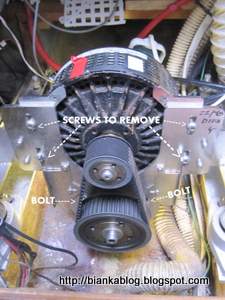
Once the screws and bolts were loosened the motor is easily slid down the bracket and the belt was easily removed:

This is also how I would change the belt too. I think it would only take about ten minutes. As I inspected the belt I could see it was still in very good shape even after five years of operation. So there was really no need to change it. I'll show how easy it was to remove the motor in the next post.

I'm usually a "if it ain't broke don't fix it" sailor. But, this year I decided to tackle replacing the shaft coupling which did not require urgent replacement but, since nothing else was pressing I decided to swap it out. More on that in a later post.
Truth is I've never had to touch the motor since I installed it five years ago but, to make for easier access to the shaft coupling I decided it would be a good idea to remove it. It turned out to be extremely easy something I did not often say when I had to do some type of maintenance on the diesel. First, I removed the stainless steel cover that enclosed the belt and pulleys:
The removal of four small cover screws accomplished this. I then removed power from the system by taking off the 48 volt battery lead. I then marked the motor case, terminals and motor cables with colored tape so I would be sure to connect them back up to the correct terminals.
If I were reconnect them wrong it would not be disastrous but, the motor would just operate in reverse of what I was use to. Better to reconnect the cables right the first time. With power disconnected and the cables marked it was time to loosen the motor to take off the belt. This is easily done by loosening four screws and two bolts as shown below:
Once the screws and bolts were loosened the motor is easily slid down the bracket and the belt was easily removed:
This is also how I would change the belt too. I think it would only take about ten minutes. As I inspected the belt I could see it was still in very good shape even after five years of operation. So there was really no need to change it. I'll show how easy it was to remove the motor in the next post.
Thursday, November 04, 2010
ELECTRIC SEAS

Sunday, May 23, 2010
A QUESTION OF BALANCE
I'm not talking about the Moody Blues album of the same name . Arguably one of the better Moody Blues albums after Days of Future Passed

 which is in BIANKA'S on board CD collection.
. Arguably one of the better Moody Blues albums after Days of Future Passed which is in BIANKA'S on board CD collection.  I noticed over the winter that one of the four batteries in the 48 volt battery bank was lagging a little behind in voltage compared to the other batteries when charging. Not by a lot but, enough that my Paktrakr battery monitor was issuing warnings about overcharging of the other batteries and undercharging of the lagging battery. This is a problem when you have multiple batteries in series in a say a 48 volt bank like I do for the electric propulsion system. The one undercharged battery can drag down the others. Because my ZIVAN NG-1 charges the bank as a whole it does not know that one of the batteries is lagging behind it just keeps charging until it's voltage and current parameters are met. How to correct this situation? I've ordered a DUAL PRO PS-4 battery charger.

This charger unlike the ZIVAN NG-1 has four individual battery chargers built in to it. Each is connected to the individual batteries in the string. So if one of the battery reaches full charge it stops charging that particular battery. Likewise if one battery takes longer to charge it keeps charging that battery and stops charging the others. This should help to balance the battery bank or at least prevent overcharging of the batteries that are not lagging. Also having the DUAL PRO on board will provide a backup battery charger and backups are a good thing when cruising.
Tuesday, February 16, 2010
ELECTRIC PROPULSION GOES MAINSTREAM
It did not take long for West Marine to see the future.


Saturday, June 27, 2009
GOING ELECTRIC PART 13: Motor on!
At this point the diesel has been removed, the area cleared out of any unnecessary items, the stringers have been extended and cut, brackets and motor mounts have been installed. It almost is anti climatic how easy it was to install the motor. But, here it is:


 I am very pleased with the installation. But, it is useless without some of the other components. Most importantly the batteries. So it's time to move on to the next phase which is installing the batteries, controller other components.

PREVIOUS GOING ELECTRIC POST
NEXT GOING ELECTRIC POST

Below is an overhead view. You can see the tabs where the wires will be connected and also the stuffing box through which the prop shaft travels. Speaking of the prop shaft....

Below is a photo of the original V drive transmission setup from the diesel days. The prop shaft ran under the transmission and engine. This made for some difficult maintenance issues of the stuffing box.
Below is a photo of what it looked like underneath the transmission. There was not a lot of room underneath to try and loosen the stuffing box nut. This made changing the packing in the stuffing box very difficult. It was also out of sight. You can also see the corrosion on the transmission flange from salt water that dripped on it over the years . The conversion to electric propulsion has made changing the packing a much easier procedure.
With the electric motor installed (below) the stuffing box is out in the open and much easier to get to compared to the photo above. This will make adjustment very easy. But, there is no free lunch. I will have to remove the Stafford coupling that connects the motor shaft to the prop shaft to replace the packing but, since it too is easily accessible and removable it is a much better setup from a maintenance standpoint.
I am very pleased with the installation. But, it is useless without some of the other components. Most importantly the batteries. So it's time to move on to the next phase which is installing the batteries, controller other components.
PREVIOUS GOING ELECTRIC POST
NEXT GOING ELECTRIC POST
Subscribe to:
Posts (Atom)


 Posts


