Showing posts with label storm. Show all posts

Thursday, June 30, 2022

WHITE SQUALL: Lessons Learned

 While BIANKA survived the White Squall conditions from a weather front that blew through the harbor a few weeks ago. The same could not be said for the dingy. The heavy rain was not an issue but, the winds blew BIANKA around and whipped saw the attached Porta Bote dingy around and may have flipped or at least turned it 90 degrees at some point. Dumping some of the contents into the water. Including one of the Oars, seat cushion, outboard motor cover and anything else that was not attached like a plastic scrapper I use to clean the dingy bottom from time to time. So when things calmed down I took some of the lessons learned from the event and implemented a strategy to try and limit the damage during a future weather event.

OARS

Losing the Oar could have made trying to get back to the shore in anything but calm conditions. Keeping them in the dingy ready to use is important. So an easy fix was to use TY Wraps to create loops where I can attach a line secured to the dingy to help keep the Oars with the dingy.


I'll cut the excess tabs but, the loop will make a good place to attach a line to secure them.

if the Oars should happen to leave the dingy again since they float it makes sense to mark them with BIANKA's name in case any one finds them floating around the harbor. There is a better chance they will find there way back to the boat.


Since the Oars come in two pieces I used a DREMEL Tool make sure both pieces had my boats name on them.

CUSHION

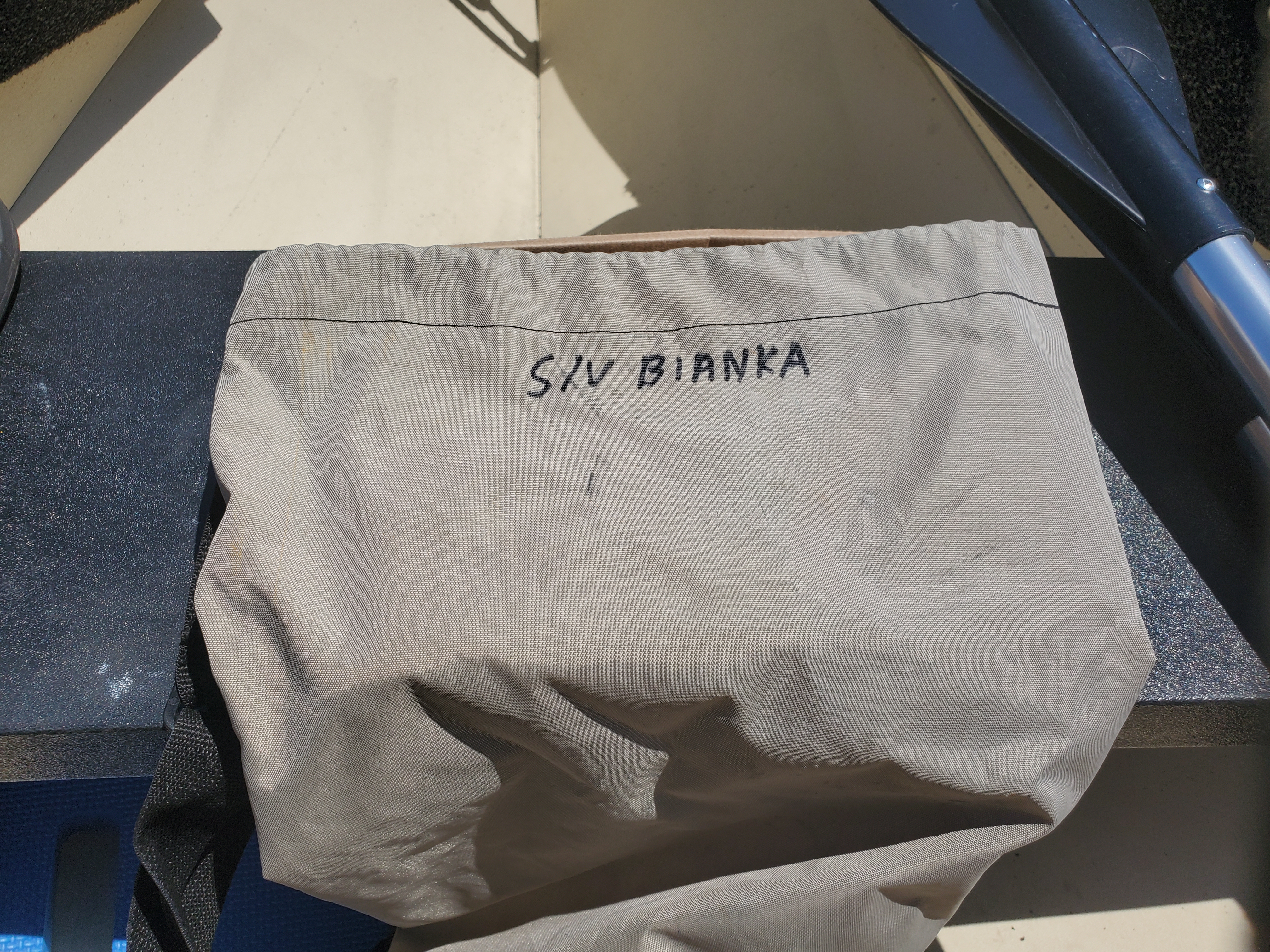
Another Item that was lost in the storm was the seat cushion. It's not only on board for comfort it's also used as a flotation device. Labeling it will also help it getting it returned should it leave the dingy again.


MISC
One item that did leave the dingy after the storm but, I miraculously found floating next to BIANKA a few hours later was the outboard motor cover. I was able to grab it with the boat hook. Still no reason not to label it too.


Friday, June 17, 2022

WHITE SQUALL AT THE MOORING


 Exciting day on the boat. Weather front came through with White Squall conditions. I think the dingy might have flipped in the storm. Lost one of the oars and found the battery for the outboard floating outside the boat. Hope it still works going to be awkward trying to row to shore with one oar.

Luckily the battery was sealed and still powered the outboard. I made it back to shore though the battery started to fade on the way. Unfortunately, the charger is back on the boat and it will be tricky getting back out tomorrow. 


Tuesday, March 20, 2018

WINTERLUDE 2018

It's been about a month or more since I last visited BIANKA. The weather has been cold and the winds blowing off Long Island Sound make it feel colder. But, since the fourth Nor' Easter is about to arrive tomorrow I figured I should make the trip. I needed to make some measurements and check on space availability for some various projects I have planned once the weather warms up.
I arrived at the boatyard a few minutes before Spring or the Vernal Equinox happened. Though it sure still felt like winter. I did the usual checkout of the deck and charged up the batteries. I then moved the piles of cushions, boxes of parts and tools so I could check the space where I planned to relocate the new Jabsco Macerator Pump. It looked very doable and should be a pretty easy job:

Which was a relief. However. the location where I planed to install a new Standard Horizon 2200 VHF radio was not going to go as smoothly.  Behind the bulkhead where I wanted to install the unit was hose and fitting for BIANKA's anchor wash down outlet.

It may require that move the outlet. But, perhaps not I'll know better once I get the unit and see how it fits. But, at least I'll be prepared to do the work.

Not much else to do in the cold temperatures on board once the batteries were topped up except to check the bilge. There was some water there. Not surprising since the boat has weather three Nor' asters and some heavy rains since I last visited. I took out the Micro Wet/Dry Shop Vac and sucked the water out of BIANKA's deep bilge. The small shop vac makes the job so much easier, faster and cleaner. 

   I empty the Shop Vac into a five gallon bucket . One that I had labeled to show one gallon for deck washing solutions.  It showed I had only about a gallon in the bilge.

Having accomplished all I had planned to do. I buttoned the boat up disconnected the power cord and went home to await the storm. Hopefully warmer Spring temperatures will soon be on the way.

Wednesday, September 06, 2017

HURRICANE UPDATE: Tropical Tidbits Update

When Hurricanes start appearing in the Caribbean I try to keep a weather eye on them. Just so I'm not surprised should they decide to head up the East Coast of the United States and into my area. Hurricane Irma looks like it will not be a threat to BIANKA. But, it is a serious storm for those in it's path. One of my go to sites on the Internet to get a handle on what's going on with these storms is Tropical Tidbits. Levi Cowan does an excellent job of independent analysis to show what is going on and what may happen with Hurricanes along with serious caveats so people don't get to complacent.  Here is the latest update:

Wednesday, September 28, 2016

HURRICANE STORM PREP: Before and After

In early September I was facing a serious dilemma. Hurricane Hermaine was heading up the coast. This meant I would have to try and prep BIANKA in advance of the storm. But, I also had booked passage on a Cruise ship leaving New York and heading to Bermuda during the same week the storm was expected to hit. Due to a number of SNAFU's and personal travel plans I had decided to give up on sailing this season and just hung out of BIANKA at the mooring. This decision was fortuitous because I did not have a need to put the sail on the boat. This made storm preparation a little easier since I did not have to remove and store BIANKA's 540 square feet of sail to reduce windage.

I did have to do a few other things to give me some piece of mind in case the Hurricane hit the area. One thing I needed to do is remove the 33 pound Bruce anchor off the bow roller.
 The flukes of which can cut easily cut through the mooring line like a knife and set the boat adrift. It's not a difficult job but, it is awkward handling the anchor while leaning over the bowsprite. An extra line helps make sure you won't accidentally drop the anchor while handling it. I was also glad I had previously coated the shackle pin threads with Tef Gel . This made for a quick and easy removal of the shackle holding the anchor to the chain. I wish the neighboring boats would do the same but, I have not seen anyone else come out and start to prep their boats.

Once the anchor was removed and the mooring pennant lines set in the bow rollers. I used several large Ty Wraps through holes in the rollers:

These will prevent the mooring lines from popping off the  rollers and start chaffing as the bow pitches up and down in a storm. This could possibly set the boat adrift.

I also made up some spare mooring lines I planned to add to the existing mooring line as extra insurance. I got the last two 3/8" thimbles at the local West Marine and sliced them into some Tenex line I had on board:

I used a hot knife to cut out the bad section of the line before installing the thimble:

 The hot knife really helps to make quick neat cuts in some of these new high tech lines.

I also used some Parachute cord to secure the BIANKA"S Solar Bimini. The bimini had survived the 95 MPH winds of super storm Sandy but a little more security never hurts when expecting a blow:


My plans to add two additional lines to the mooring did not work out since the attachment point on the mooring ring did not allow room for two shackles so I was only able to add one line:

This was better than nothing. Though it would have been better to find this out before a storm approaches. I may see if the boatyard can increase the size of the mooring ring next year so I can fit two additional storm shackles instead of just one.

A LESSON LEARNED: Hermaine did not hit the area full strength which I was glad to learn of while on the cruise ship. There were some strong gusts but, nothing near Hurricane strength. However, after I returned and was rowing out to the boat for the first time since returning from the cruise. I saw that my spare storm mooring line was dangling in the water. I thought at first it had broken even though it was rated at over 5,000 pounds. When I inspected it this is what I found:

Apparently, I had secured the shackle pin to the thimble with a Ty Wrap to but, I had forgotten to do the same to the shackle that attached to the mooring ring. As a result of the pitching up and down the pin loosened up and eventually fell out make my spare storm mooring line useless. When this happened is anyone's guess. But, it is a lesson learned to make an inspection list before leaving the boat when prepping for a storm.

Sunday, September 04, 2016

TRYING TO REASON WITH THE HURRICANE SEASON: Hurricane Hermine


It was a delightful week on board until Hurricane Hermine threatened to show up. Which meant I need to start thinking about prepping the boat should it arrive. Adding to the tension was the fact that I would be away for the time the storm was supposed to hit. So should something happen to the boat it would be several days before I could get back to check on it. This was a similar situation to several years ago when Hurricane Irene hit the area. But, back then it was because I was working 250 miles away from the boat. This time I am retired but, will be 600 miles away and on another boat. Though the one good thing about my decision to scrub the sailing season is I never put on the sail so I did not have to take it off on prepping for the storm. Still being so far away from the boat and not being able get back to check on her post storm is somewhat disturbing. But, one can only do what one can the rest is up to the nature of the storm.

Tuesday, May 17, 2016

SQUALL AT ANCHOR 50+ KNOTS

 I've been out traveling for the past few weeks and so have not posted anything in awhile. But, here is a video I took while cruising in the Exumas when a squall came through one morning. It did not last long but, long enough to rip apart the dodger which you can see flapping at the top of the screen in part of the video. The boat behind us also had it's dingy flip over with a brand new outboard attached:

Friday, January 29, 2016

RIDERS ON THE STORM

I spent most of January cruising in the British, U.S. and Spanish Virigin Islands. Even though the Jonas Blizzard/Nor' Easter that hit the United States east coast last week was 1500 miles away. My cruising trip in the Caribbean was affected by it's formation over the Atlantic. The easterly winds we had been enjoying since we started sailing on January 12th suddenly started to veer out of the south. As shown in the video below. The X on the video shows the approximate location of the boat I was on:


I was feeling pretty good as I first heard of the storm approaching the northeast area.   I had recently left the northeast to spend a few weeks cruising in the warm Caribbean to escape part of winter. I did not expect the storm being 1500 miles away for it to impact my travels on board. But, when the winds switched to the south and started to feed into the storm the waves also picked up. When the reefs along Culebra  were hit by waves it made for very poor visibilty for snorkeling for several days. Though on the plus side we did have a nice sail over to Fajardo from Culebra. Though it was a sobering lesson on how powerful these winter storms can be.

Saturday, October 03, 2015

ADIOS HURRICANE JOAQUIN, HELLO GALE

It's with some relief that hurricane Joaquin will not be making landfall here as it tracks out to sea. But, these nor' easter conditions is no day at the beach either. It's been blowing a pretty steady 20 knots in the harbor. I've measured gusts as high as 32! It was apparently too much for this day sailing cat boat on a mooring near BIANKA:


Which sunk sometime during the night. I thought I saw the young owners on the beach trying to comfort each other as they came to check on their boat. Meanwhile, the gale warnings continue into tomorrow. I'm looking forward to the winds calming down. But, perhaps this is what happens when a boat on a neighboring mooring is named Storm Chaser:


Wednesday, September 30, 2015

HURRICANE JOAQUIN

BLOG UPDATE 10/2/15 10:46 PM
On board and waiting for the winds to stop. Thankful that Joaquin looks like it will be heading out to sea and not hitting this area.  The current Gale warnings are exciting enough. Clocked a 30 knot gust on the mooring today. Winds have been relentless since yesterday afternoon:

"..STRONG WINDS AND ROUGH SEAS INTO THIS WEEKEND...
ANZ335-031000-
/O.CON.KOKX.GL.W.0022.000000T0000Z-151004T2200Z/
LONG ISLAND SOUND WEST OF NEW HAVEN CT/PORT JEFFERSON NY-
339 PM EDT FRI OCT 2 2015

...GALE WARNING REMAINS IN EFFECT UNTIL 6 PM EDT SUNDAY...

* WINDS AND WAVES...NORTHEAST 15 TO 25 KT WITH GUSTS UP TO 40 KT.
  WAVES 3 TO 5 FT.

PRECAUTIONARY/PREPAREDNESS ACTIONS...

A GALE WARNING MEANS SUSTAINED WINDS OR FREQUENT GUSTS OF 34 TO
47 KT ARE EXPECTED OR OCCURRING. OPERATING A VESSEL IN GALE
CONDITIONS REQUIRES EXPERIENCE AND PROPERLY EQUIPPED VESSELS. IT
IS HIGHLY RECOMMENDED THAT MARINERS WITHOUT THE PROPER EXPERIENCE
SEEK SAFE HARBOR PRIOR TO THE ONSET OF GALE CONDITIONS."


BLOG UPDATE 10/1/15 12:14PM

Just got this email from the Town:

"Dear Mooring Holder,
The National Weather Service is forecasting heavy rains, high winds and coastal flooding over the next several days, with the possibility of Tropical Storm Joaquin making landfall in the area early next week.
 Because of this, we strongly recommend that all boat owners take necessary precautions to secure their vessels or remove them from the harbor in advance of this severe weather."


This is not shaping up to be fun weekend on the waters here on the Isle of Long. Hurricane Joaquin may be making it's way up the coast. But, before it even may even arrive we will have gale conditions on Friday into Saturday and coastal flood warnings are already in effect.  Time to prepare and hope BIANKA's luck holds out through another storm.

BLOG UPDATE 10/1/15 : 


I went down to the boatyard to see went to the boat yard to see what the scuttlebutt was about the weather and Hurricane Joaquin. Though the persistent northeasterly winds have kept piling up the water in Long Island Sound. So much so that coastal flooding is already occurring. I had to make a detour to reach my destination because of the flooding. This even before Hurricane Joaquin influences the area.

Saturday, May 09, 2015

UH OH!


BIANKA is not yet in the water but Tropical Storm ANA has formed off the southeast United States. I'm a little concerned as the storm makes it's way up the coast. But, there are a few good things in my favor:

1) One thing is the boat is still on land.
2) The mast has been unstepped which means less windage and stress on it.
3) The brutal cold winter has meant that the waters around Long Island are colder than normal and so should knock down the storms strength.

All of the above help ease my fears about the storm doing any major damage but, I'll be keeping a weather eye on it.

Wednesday, October 29, 2014

Remembering Sandy


It was two years ago the superstorm Sandy hit the area.  I went down to the boatyard in the morning before the storm hit but, the winds had already whipped up Long Island Sound into very rough conditions:


In addition water was already flooding over the only access road in or out to the boatyard. So I was only able to catch a quick glimpse of BIANKA still at her original location before I had to hightail it out of the area or be stuck for as the storm hit. I choose to head back and just barely beat the flood waters:


After the storm passed I found BIANKA a thousand feet from where I had left her the day before. Luckily undamaged and still floating. Which was good since I moved back on board since there I had power thanks to the solar and wind turbine and also the Honda 2000 generator. I also had Internet access via the cell phone. While back on land many did without these due to power lines being down for weeks.  The storm also taught me some important lessons.  .


Monday, August 12, 2013

WHY BOATS SINK: Things that go bump in the night!

I was sitting on a beach chair out on the eastern end of the Isle of Long staring out into the Atlantic about two weeks ago. About fifty feet away from where I was sitting was this:

It was part of a tree about thirty five feet long that was partially buried at the high tide mark another 12 foot piece of the same tree was lying a few feet away. It looked pretty nasty down by the root end:


As thought about the tree and wondered where it came from. I was thinking it is probably a traveler left over from Hurricane Sandy's vist to the area last fall:

I wondered how many other tree trunks were floating out there in the Atlantic vagabond leftovers from the storm? Depending on  the boats construction and how it hits such a piece of debris it could severely damage a boat or maybe damage a prop. It would be hard to see to especially at night. Just another thing to be aware of out on the waters. Coincidently, the tree was located at almost the exact spot that I saw an immense log rolling around in the surf a few years ago. Here is some video of that hull crusher I took with a cell phone:


As I sat back down in my beach chair I made a mental note myself to remember even on a beautiful sailing day there are still things lurking just below the surface that could ruin your day.

Wednesday, May 22, 2013

ALL IS LOST: THE MOVIE

The  film ALL IS LOST with Robert Redford is causing a lot of talk at the Cannes Film Festival. Looks interesting but, those of us who have spent enough time on the water already know that "stuff happens" on the water  usually at the worst possible time. Here is a trailer from the film.

Thursday, April 11, 2013

BUH BYE SANDY!

"Sandy has been retired from the official list of Atlantic Basin tropical cyclone names by the World Meteorological Organization’s hurricane committee because of the extreme impacts it caused from Jamaica and Cuba to the Mid-Atlantic United States in October 2012. "- NOAA

No complaints from me. Even though I was one of the lucky ones. The day after Sandy hit I found BIANKA over a thousand feet away from where I last saw her the morning before. She was still attached to the mooring just not where I left her.  Here is some video I took of Long Island Sound in the morning before Sandy hit. Already Long Island Sound waters had covered the beach and were starting to crash onto the parking lot:


Here is a short video of me just barely making it off the spit area as the rising waters covered the roadway leading away from the harbor:


Sunday, March 24, 2013

THAT WAS QUICK

I went down to the boatyard again on Friday to look for the Kings Loran manual that a sailor in Norway asked me about. While there I found out my new 500 pound mooring was already rigged up and ready to be dropped. But, that also meant the bill would soon be coming in the mail too.  At least I'll be able to relax a little in case another storm like Sandy heads this way knowing the mooring is 200 pounds heavier and has some new chain on it.

Friday, November 23, 2012

500 FEET OF SEPARATION

With BIANKA stored safely away for the winter I've been wondering what was going on around BIANKA as Sandy hit the area. I wish I knew when she made her move across the harbor.  I know she was still at the same location at 11 AM Monday October 29th the day the storm hit. On Tuesday morning she was located over one thousand feet to the southwest still attached to her mooring and floating thankfully. Looking around on You Tube I found footage of what was going on just two miles down the coast from were BIANKA was moored and what the conditions were like on Long Island Sound which was just across the road from where BIANKA was located:


Watching this footage reminds me how lucky BIANKA was. Just 500 feet of a low lying spit of land separated the mooring field where BIANKA was from these conditions. She was protected from the brute force of Sandy but, could not hold on when the storm surge became too great with the the northeast winds of Sandy continually flooding water into the harbor.  I was thinking that maybe a well protected cove located inside of Port Jefferson Harbor might have been a better place to be as it was protected by high bluffs from the north, east and south as shown here:

But, after looking at this video that might not have be such a good idea after all:


No doubt the coastline has changed and there has been a lot of erosion but, to see what the Sound is like in more normal conditions this flyover video of the area shows how the normally rocky beaches (those that are still there)  have ironically become rather "Sandy". While the video below shows how some areas have no beach at all anymore:


Now we wait to see if the winter storms will create further changes.

Friday, November 16, 2012

WATTS GOING DOWN ON LAND AND SEA

I have mentioned that those of accustomed to living on boats may have an easier time than those who are only living on land after storms like Hurricane Sandy. That's because cruising on a boat like BIANKA involves getting away from land as much as possible. My boat is usually on a mooring or anchored off in some picturesque spot that pleases me. Very rarely will I tie up to a marina's dock. So one is well aware of how much power one can use and where it comes from. We sailors know it is not seemingly unlimited and always available at the flick of a switch. Millions of people who reside on land including the residents of lower Manhattan had a "reality bites" experience after Hurricane Sandy blew through the area. They might learn a thing or two from sailors like myself who have taken some of the technology that worked so well on board our boats and have transferred it sucessfully to land based structures. You can save quite a bit of power (watts), money  and have an automatic emergency back up system to illuminate the rooms in your house at the same time.  Like my whole house LED lighting system:


I have converted many of the lights on board BIANKA to energy efficient LED's from the masthead anchor light to the ones over the galley and cabin.   They worked so well in the boat I wondered how they would do in the house. So I went about building a simple system that would meet my needs. It's easy to do with off the shelf components the heart of which is a Morningstar SL-10L-12V SunLight 10 Amp Charge Controller LVD .


This unit does a number of things. 

1) It turns on up to 10 amps of 12 volt LED lights at dusk and off at dawn. It also has timed switched presets if you don't won't to have the lights on all night.  

2) It controls the charge to battery from the solar panel(s). It also has a jumper to select charge profiles for Flooded or Sealed batteries. 

3) It uses the output of the solar panels to sense when dusk begins and turns on the lights and also when dawn begins and turns them off. 

4) It has a low voltage disconnect it will disconnect the lights from the battery bank once the battery voltage drops below 11.8 volts to protect the battery bank until the solar panels once again are able to start charging the battery again.

Connections are simple:
Two terminals are for the solar panel connections.
The next two terminals are for the 12 volt battery
The last connections are for the wiring to the LED lights.

I use In-line AGC Fuse Holders on the output to LED lights and the battery to protect against a short circuit. It's for safety and I recommend it.
Two Siemens 12 volt 75 watt solar panels that were left over from a boat project that changed direction provide the charging for the batteries. I've mounted them on the south side of the house.

As you can see one has not yet tilted one of the panels for optimum sun exposure but, it's on the to do list though the system works fine as is anyway.  

 The batteries are two Sealed Lead Acid Battery (12V; 35 AH; UB12350) batteries connected in parallel. 


The only reason I am using two is because one arrived with the lug damaged and the other one was the replacement. So rather than just have one sitting around sulfating I put both of them to work on the LED house system.

I use two types of LED's in the system. One is a   Disc Type G4 Base Side Pin 6 SMD LED 10 - 30 Volt DC  unit. I like to use the warm white version.
It also has a buck regulator that keeps current regulated so that the LED junctions do not overheat and fail due to voltage or current fluctuations in the wiring. It's something you should look for in any LED's you use on board the boat or at the house as a slight variation in current or voltage can blow the LED electrical junctions destroying the LED.

The other LED light I use is the BEKA Light from BEBI Electronics. ( BLOG UPDATE: Bebi Electronics is no longer selling LED Lights )It was designed to be used on a boat as a cockpit anchor light. But, I use them in the house when I want to illuminate bigger rooms like the living room or dining area. I ordered mine with warm colored LED's facing downward and the bright white LED's for the outside  perimeter facing ones.  


 The downward facing LED's  provide a warm incandescent like look directed downward. While the bright white LED's bounce off the walls and illuminate the room with a bright indirect light.

Just about every room in my house is lit up by one of these two LED lights. They provide enough illumination so you can walk from room to room without ever having to turn on a light. Since they are charged by solar energy once the system is in place there are no additional costs and the rooms are lit from dusk to dawn. During Hurricane Sandy my neighbors wondered why I was the only one who seemed to have power when they saw my LED lights on. On the boat it's all about saving as much energy as possible by being as energy efficient as possible. On land this also has the added benefit of saving you money and also providing light when the electrical grid goes down as it did after Hurricane Sandy.  

Monday, November 12, 2012

LESSONS LEARNED FROM HURRICANE SANDY

It's been almost two weeks since Hurricane Sandy came ashore and decimated parts of the northeast United States especially those living near the shore areas. I was pretty lucky despite finding BIANKA over a thousand feet away from where I left her the night before the storm I found her floating and still attached to her 300 pound mooring. Here are some of the lessons I learned from Sandy:

1) Putting an extra line on the mooring works well as a precaution to keep the boat attached to the mooring. I probably don't need to attach the anchor chain on board to the mooring chain as I did when Hurricane Irene threatened last year.


2)  The surge from a storm is going to have a big impact on weather the boat stays put or decides to wander across the harbor. I may need to think about adding additional anchors to the mooring chain to try and keep it in place or close to it when the tidal surge comes in. This will involve some prep and diving before the storm hits. Perhaps a heavier mooring might be in order.  Upon inspection earlier this year the eye of the mooring was showing quite a bit of wear following last years Hurricane Irene.
This yearBIANKA's mooring had a new eye welded on to it at the beginning of the season. I'll be interested to see what it looks like when it is pulled after Sandy.


3)  I need to be more thorough in making sure I have dogged the hatches. I'm still amazed I missed  latching the overhead hatch in the forward cabin. It was closed but, not secure.

The winds from Sandy were able to lift it and fling it wide open damaging the Charlie Noble vent for the water heater. Luckily there was not a lot of rain when Sandy hit the area and I only found about an inch of water in the bilge and a damp bed quilt.

4) The solar bimini with it's solar panelsI built over the cockpit is strong enough to stand up to hurricane force winds and there is no need to take it down before the storm. The design has now been through three hurricanes with Sandy's gusts to 95 MPH being the strongest so far. I do have to secure the clear  Lexan centerpiece better as the two screws holding it to the frame were not enough to hold it in storm conditions but, that was just a temporary install at the time Sandy hit anyway.


5) I should have probably taken the sail down below. I did for Hurricane Irene last year. But, this time I opted not to do it. I was on the boat the day before Sandy and the winds were blowing 30 to 35 knots at times and the boat seemed to be riding well. So I opted to leave them on. Not sure how much of difference it would have made since BIANKA's beam is over 11 feet and there were plenty of other boats that dragged that had there sails stripped off of them. But, in the future I will store it below when another storm threatens.

6) I ran out of propane about two weeks before Sandy. Even though I was heading out on a fall cruise I opted not to refill the propane tank  since it was toward the end of the season. I thought I would refill it in the spring. I would use my backup cooking devices for the few remaining weeks. One of my backups is a butane single burner stove. I bought some additional butane canisters but, when I went to try it I found the butane did not flow to the burner. Some parts looked a little corroded  and I did not think it safe to use it.  I then went to my second backup which was a  Coleman PefectFlow 1-Burner Stove which works very well 

as a backup but, can only be used at an anchorage in calm conditions because cooking pots and pans are not secure from toppling over. Luckily, I bought some extra Propane Fuel Canisters  for it's use before Sandy hit. Because they might have been scarce after the storm knocked out power and some people on land would be using alternate cooking devices like I was.  As it was I was on my last propane canister when power was restored back at home and was beginning to wonder if I would be able to find more if I needed them. So getting the on board propane tank refilled should be a priority if one wants to be able to move on board after a storm without worry.

7) Communications can get spotty after a storm like Sandy hit's. At first things seemed to be ok but, as the days wore on and the batteries and generators of the cell phone towers ran down communications began to get flaky. Cell phone calls dropped out, internet access via the cell phone modem was slow or non existent at times.  It seemed that emails sent from my Blackberry were the most reliable form of communications when the others were not reliable.


8) Having an  Engel Portable Refrigerator - Freezer and a cooler on board was a great asset to have. I made the decision to move on board primarily because I had all my basic needs available there. Including refrigeration with the Engel . I was able to empty the freezer at home and store most of the frozen items in the Engel in freezer mode and use the Coleman cooler for the items that just needed to be refrigerated. So I threw very little of the food at home away and had plenty for a week of meals on board the boat without having to find a supermarket or grocery store. I took frozen items from the Engel and defrosted them in the Coleman cooler as needed where it helped to keep the cooler items cold too. As I emptied the Engel I froze plastic water bottles to use as the ice ran out in the cooler.


9) Since I was just getting back from a 200 mile fall cruise as Sandy approached I did not refill the gasoline jerry jugs I use for the Honda 2000 generator. I was winding down the sailing season so I had less than a gallon left of the six gallons I usually carry when cruising. Again since it was toward the end of the season I saw no need to refill them. But, after Sandy hit a lot of gas stations had no power for several days and then after power was restored there was a run on gasoline and they were soon shut because they no longer had gasoline. Even as I write this two weeks after the storm gasoline is being rationed by a system of odd and even license plate days. So the lesson learned when a storm threatens refill the jerry jugs before it hits. It turns out I did not need to run the Honda 2000 generator that much. I only ran it for a few hours one day out of the seven I was on board. But, if I had to use it more I might have run out of gas before too long. So the lesson is to keep your fuel supply topped up and ready until you are sure you won't need it. The same goes for the water tanks.


10) Having solar and a wind turbine on board is a real plus for after storm living. As I mentioned above I only had to run the Honda 2000 generator one day for a few hours. That was because we had a some cloudy days during and after Sandy and with the ENGEL running in freezer mode it was draw a few more amps than usual. But, after things got charged up I was able to use both the 12 volt house bank and the 10 kilowatt 48 volt propulsion bank efficiently.  During the day when the sun was out I would power the Engel freezer from the 12 house bank as the two 75 solar panels were able to power it and charge the house bank  a little. I used the 48 volt propulsion bank to power my laptop as I checked emails and blogged. In the evening after I was done using the computer I would then power the ENGEL freezer from the 48 volt bank because in addition to some solar I also had the Marine Air X 48 volt wind turbine helpeing to charge things overnight. I needed to use the 12 volt house bank to power some LED lights and a small radio.

In short I found that after a storm reeks havoc on land moving onto ones boat is better way to weather the aftermath until things get back to normal on land. Provided of course you already have the systems and provisions on board to live for an extended time at anchor which I did.