
Thursday, August 25, 2011
AND IT GET'S SUCKIER!


Wednesday, August 24, 2011
WELL, THIS KIND OF SUCKS!
This is one of those times when I hope the NOAA people get it wrong. Expecting tropical storm conditions on the Isle of Long for the weekend. I guess the good news is they are not calling for Hurricane conditions. At least not yet.


HARBOR EARTHQUAKE
I got a call from my girlfriend who was in Washington D.C. She started the call with "I'm alright." O.K What happened? I replied. Didn't you hear about the earthquake about twenty minutes ago? she asked. I had not though I was busy at the dock filling the water tanks and putting stuff away before heading out on a mini cruise. But, thinking about it more. I did feel it. Though from where I was down below it felt like some powerboat with some very heavy horsepower on board was starting up nearby. So I really did not notice it as an earthquake. Now if the harbor had started to empty out pre Tsunami like. Now that would have got my attention.
Monday, August 22, 2011
SOLAR BIMINI: PART TWO: Plan B!
Well the first idea of using the existing dodger frame to mount the solar panels worked out well for a few years:
 The sail cleared it fine when tacking. I installed some Lexan
 in between the panels which not only helped keep things dry under the hatch but also allowed me to view the sail as I raised it. I was happy with this plan until one of the hanger lines broke and dropped the sail a few inches and a reefing line I suspect grabbed a corner of the solar panel and broke the 1" aluminium angle
 used to hold the solar panel. Time for Plan B.
Plan B was to lower the solar panels so they did sit so high above the stainless steel frame where an errant line could once again grab it. To do this required I buy a few more jaw slide hinges . But, letting the jaws hang below the frame instead of above as shown here:

I then cut up the remaining aluminum angle into four pieces:
 I drilled mounting holes so they could be attached to the jaw slides and they would cradle the solar panels in between the dodger frame and not above it:
 This was a better idea and there was less chance of a line getting caught on a panel compared to the first setup. It is not perfect because the stainless steel frame of the dodger is lightly curved and the aluminum angle is straight so there was some distortion in trying to mount the solar panels to the aluminum angle but, it can be done. This was phase one of the project. When I added some additional panels to make a solar bimini over the cockpit and provide the panels that would help charge my electric propulsion system I came on an even better solution to mount the panels.
 in between the panels which not only helped keep things dry under the hatch but also allowed me to view the sail as I raised it. I was happy with this plan until one of the hanger lines broke and dropped the sail a few inches and a reefing line I suspect grabbed a corner of the solar panel and broke the 1" aluminium angle used to hold the solar panel. Time for Plan B.
Plan B was to lower the solar panels so they did sit so high above the stainless steel frame where an errant line could once again grab it. To do this required I buy a few more jaw slide hinges
. But, letting the jaws hang below the frame instead of above as shown here:
I then cut up the remaining aluminum angle into four pieces:


Thursday, August 18, 2011
SOLAR BIMINI: PART ONE: Plan A!
When I bought BIANKA in 1995 it came with a nice heavy duty vinyl coated dodger with windows:
 It also had an extension that could be zipped onto the back of the dodger when at anchor. Which also had sides to enclose the cockpit if one wanted too:

It offered real nice protection from the elements but, was also hot in summer because it blocked the refreshing breeze when the windows were installed. Though you could unzip them and roll them up which I often did. Like many things on a boat exposed to the sun and elements it deteriorated over time. Zippers break, threads wear out, plastic glass windows crack etc... I restitched things a few times but, eventually it became time to replace it. As I pondered what I would replace it with I started thinking about durability. Sunbrella is often the fabric used by most boatowners but, it always seemed to me that in a few years that would have to be replaced again too. Around this time I was also thinking about adding some solar panels. Hmmm. I wondered. Why don't people use solar panels instead of fabric for the tops of dodgers? Why not indeed! It is much sturdier and would last much longer than fabric and it would also serve to provide power to help charge the battery bank. A dual purpose solution always works for me. So I decided to go about replacing the worn vinyl dodger with a solar powered one.
I wanted to use the existing dodger frame. It seemed sturdy enough to hold the two 75 watt Seimens solar panels I bought. At four feet long they were just about the perfect size to fit on top of the dodger frame on the port and starbord sides. There might be a little shading on occassion from the sail and boom on one of the panels but, at least one panel would probably be in full sun during much of the day. If I got anal about it I could tie the sail off to one side and get both panels in the sun if I wanted. This is starting to sound like a plan.
At first I thought I would drill holes through the frame and attach the panels directly to them. But, I found that drilling trough stainless steel is pretty hard and I thought holes might weaken the frame a little too much so I abandoned that idea early on. I then came up with what I thoughT was the perfect solution. I would use hinged jaw slides to clamp around the 7/8" dodger frame and install the solar panels to them. I then thought I could save a little money and use less clamps if I use two pieces of aluminium angle
 to mount the solar panels onto before attaching the brackets to the clamps. The advantage to this is I would only need four of the hinged jaw slides for the whole dodger instead of four for each panel like I originaly thought. So that was plan A:


This worked out well for a number of years sailing in all kinds of conditions and weather until last year. When a broken hanger line grabbed the edge of one the solar panels and broke the aluminum bracket holding the solar panel almost taking it over the side. Resulting in a scramble by me to do some serious damage control since I was sailing solo in near gale conditions at the time. Well so much for that idea! It's time to move on to "Plan B".


It offered real nice protection from the elements but, was also hot in summer because it blocked the refreshing breeze when the windows were installed. Though you could unzip them and roll them up which I often did. Like many things on a boat exposed to the sun and elements it deteriorated over time. Zippers break, threads wear out, plastic glass windows crack etc... I restitched things a few times but, eventually it became time to replace it. As I pondered what I would replace it with I started thinking about durability. Sunbrella is often the fabric used by most boatowners but, it always seemed to me that in a few years that would have to be replaced again too. Around this time I was also thinking about adding some solar panels. Hmmm. I wondered. Why don't people use solar panels instead of fabric for the tops of dodgers? Why not indeed! It is much sturdier and would last much longer than fabric and it would also serve to provide power to help charge the battery bank. A dual purpose solution always works for me. So I decided to go about replacing the worn vinyl dodger with a solar powered one.
I wanted to use the existing dodger frame. It seemed sturdy enough to hold the two 75 watt Seimens solar panels I bought. At four feet long they were just about the perfect size to fit on top of the dodger frame on the port and starbord sides. There might be a little shading on occassion from the sail and boom on one of the panels but, at least one panel would probably be in full sun during much of the day. If I got anal about it I could tie the sail off to one side and get both panels in the sun if I wanted. This is starting to sound like a plan.
At first I thought I would drill holes through the frame and attach the panels directly to them. But, I found that drilling trough stainless steel is pretty hard and I thought holes might weaken the frame a little too much so I abandoned that idea early on. I then came up with what I thoughT was the perfect solution. I would use hinged jaw slides
to clamp around the 7/8" dodger frame and install the solar panels to them. I then thought I could save a little money and use less clamps if I use two pieces of aluminium angle to mount the solar panels onto before attaching the brackets to the clamps. The advantage to this is I would only need four of the hinged jaw slides for the whole dodger instead of four for each panel like I originaly thought. So that was plan A:

This worked out well for a number of years sailing in all kinds of conditions and weather until last year. When a broken hanger line grabbed the edge of one the solar panels and broke the aluminum bracket holding the solar panel almost taking it over the side. Resulting in a scramble by me to do some serious damage control since I was sailing solo in near gale conditions at the time. Well so much for that idea! It's time to move on to "Plan B".
Sunday, August 14, 2011
BIANKA'S BOOKSHELF: SAND THE NEVER ENDING STORY

Sand to us sailors can be both a friend and foe depending on the circumstances where we encounter it. If a sailor makes a miscalculation in navigating it is better to run aground on sand than hard rock or a reef. Sand can also make anchoring and holding the boat to the bottom in a blow difficult or if it is only a few inches deep and obscures a hard rock bottom beneath the holding will not be good. It can also clog the raw water intake of boats with engines that run aground. So it really behooves a sailor to really get to know as much as possible about one of the most abundant materials on earth. That's what Michael Welland has done in his book SAND: The Never-Ending Story .
. It is a fascinating book about sand, those who study it and how it behaves and what it is made from. Things you learn about sand in Welland's book include: The earth's most common element in the crust of the earth is oxygen and the second most common element is silicon. Together they form the mineral quartz which makes up 70% of all the sand grains in the world. But, sand can be made from biological materials too like shells:
 |
| Photo taken by Capt. Mike on Assateague Island |
You will also find out a lot about how sand behaves. Like why the sand builds up behind the broken shell in the above photo and why only the white sand does so. Why grains of sand will move easily in underwater currents creating shoals that we sailors need to avoid but, mud will not. Sand can also travel overland quite easily too as shown in this photo I took on an island off the coast of Mozambique:
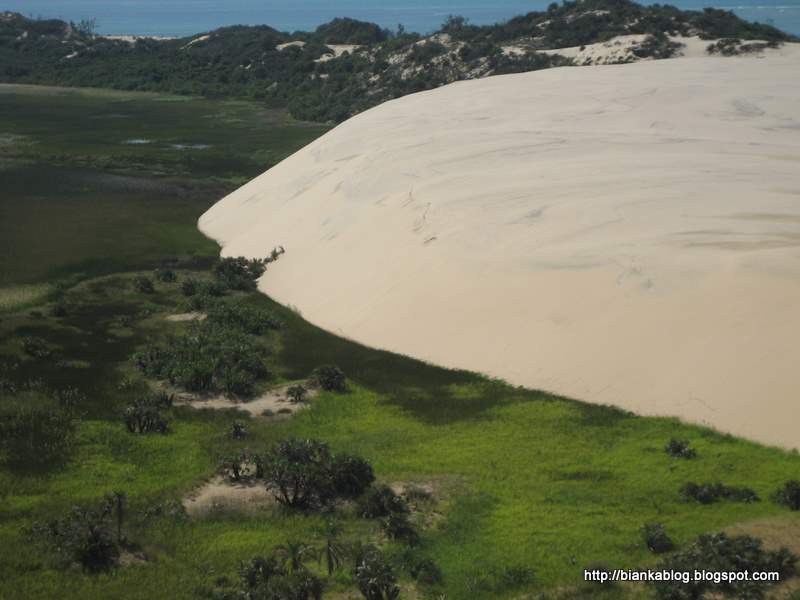 |
| THIS DUNE ON AN ISLAND OFF MOZAMBIQUE IS ABOUT 100 FEET HIGH |
Even if you don't sail like I do but, spend your time just sitting on a beach. Reading the book SAND you will find out about the eco system that resides in between those grains of sand on the beach you are walking on and not just those creatures you see are on top of it.
you will find out about the eco system that resides in between those grains of sand on the beach you are walking on and not just those creatures you see are on top of it. 
I happen to think it is the perfect book to read on the beach too!
A billion sand grains are made every second and it's not going away anytime soon. The book SAND by Michael Welland
will give you new insight into a material you might have previously taken for granted. Still think sand is not interesting? Take a look at this: Markus Kayser - Solar Sinter Project from Markus Kayser on Vimeo.
Sunday, August 07, 2011
Saturday, August 06, 2011
DINGY BECOMES ELECTRIC
 Shout out to Eugene O'Neill
 for help with the title today. I still carry a Honda BP 2 outboard on board for occasional use with my 8 foot Porta Bote dingy. I actually have not used it since last September. It is still running good but, at some point it will have to be replaced. So that's why I'm always interested in what's happening in the electric outboard market with products like the Electric Paddle and from those from Torqeedo. I've already posted about the Torqeedo 1003 and my thoughts on it. Today I came across two reports from down under in Australia concerning recent tests using a Torqeedo 1003. The first was a 19 nautical mile trip in an inflatable using 160 watts of solar panels as some additional supplemental power. The second trial was with a 12 foot Porta Bote which was of real interest to me since I'll probably be using an electric outboard on my 8 foot Porta Bote dingy.
Thursday, August 04, 2011
SHORELINE: Good Intentions
Hanging out on a boat just offshore offers a unique view of the shoreline and how the people and other creatures use it. With the fishing pole by his side I'm sure this fellow came to the harbor with good intentions to do some fishing but, somehow the washed up piece of dock looked like a good place to take a nap instead:

It also reminds me I need to put this Otis Redding tune onto my IPOD SHUFFLE
 .

It also reminds me I need to put this Otis Redding tune
onto my IPOD SHUFFLE.
Monday, August 01, 2011
THE SQUALL RULES!: Anatomy of a sinking.

Recently I was listening to reports on VHF radio from the Coast Guard of a sunken vessel north of Ellis Island in New York Harbor. I was wondering how that vessel got there. A post at Learning To Sail I think has the answer to my question:
"Yesterday evening a squall rolled through the harbor with terrific force. The anemometer aboard Willy Wall, our floating clubhouse, registered a peak of Force 9--that's a "Fresh Gale" on the Beaufort Scale, meaning up to 54 mph of wind. The Manhattan Sailing Club's Wednesday round of racing was caught squarely in the middle of it, as well as some other sailboats in the middle of what was otherwise supposed to be a splendid sunset sail."
What could go wrong here? Julian at Learning to Sail has the photos and story of the sinking along with some really good advice that all sailors should think about before and after heading out on the water like:
"Whether you are planning a long car trip, an aircraft flight, or a sailing trip, risk assessment and risk mitigation are important parts of the go/no-go decision. Weather is one of those risks that applies to all souls on the road, in the air, and on the mane. Apps abound to watch it from afar, but looking up and around is free, and there's always Hal on WX-1."
"It's better to be on the dock wishing you were out sailing, than out sailing wishing you were on the dock."
"We lost one boat last evening, and it would have been more if some frisky, on-the-ball sailors hadn't been able to STRIKE SAIL, NOW! Can't do that if your halliards are thrown down the hatch in a ball instead of figure-eight coiled on your winch. Can't do that if you hung 'em backwards."
The sinking of the Grand Republic also dramatically makes the case of why you and your crew should always be wearing a PFD
 when getting on the boat.
Subscribe to:
Posts (Atom)


 Posts


