Thursday, January 30, 2014

PETE SEEGER'S LEGACY A SAILOR'S APPRECIATION

"What can a song do? What can a sailboat do? Some would say music exists just to soothe or distract people from their troubles. Some say sailboats are just rich men’s toys. Wrong, wrong. In the summer of 1969 they helped to start cleaning up a river." -Pete Seeger


Pete Seeger passed away earlier this week at the age of 94. I think of him often when I take BIANKA sailing on the Hudson River. Usually it might for a just few days to spend some time enjoying one of my favorite anchorages near Hook Mountain. But, I have also taken my boat on up the river all the way up to Albany when I sailed my boat into Canada for a Nonsuch Rendezvous back in 2002. To me Pete Seeger's legacy will always be his efforts to raise awareness and money in efforts to clean up the Hudson through his help in founding  of the Clearwater organization in 1966. The efforts of he and others have paid off so much that the Hudson River known as  America's River because of it's place in history is considerably cleaner today than it was just a short time ago. So much so that people including me can once again swim in it's refreshing waters.  One of his major efforts was helping to raise money to build the CLEARWATER a 106 foot gaff rigged replica of a Hudson River sloop. The type of sailing vessel  that plied the Hudson in the 1800's. I often come across it sailing in my cruises to New York and elsewhere.
I'm sure that like the Hudson River every time I see the CLEARWATER from now on from the cockpit of BIANKA I'll always remember Pete Seeger and the efforts of he and others in helping to clean up one of America's most beautiful waterways and start singing one of Pete Seeger's tunes about the Hudson River.


Monday, January 27, 2014

FISHING WITH A PURPOSE


I have rarely fished from BIANKA despite often having fish jumping around the boat in the evening. I keep thinking about it from time to time. But, until I implement the stern washdown system the idea of cleaning the deck after catching and cleaning the fish seems like a lot of work for a boat that stays on a mooring and not at a dock. Then I came upon this story of a charter boat captain who routinely tags and releases fish he catches. One of his tags showed up after 16 years on a 1,200 pound Blue Fin Tuna:

"In 1997, Anderson was working the Mudhole, a fishing spot southeast of Block Island. A man on his boat caught a very young bluefin tuna, weighing just 14 pounds. Anderson, of course, tagged it and returned it to the ocean.
As the years passed, bluefin tuna grew ever more valuable and ever scarcer while Anderson continued to take sport fisherman out to sea aboard his charter boat, the Prowler.
Then, about a month ago, a fisherman out of Nova Scotia was tending his longlines about 700 miles offshore when he hauled aboard quite a catch. It was a bluefin tuna weighing an estimated 1,200 pounds."

I might start doing the same there would be less mess and I would not have to worry about constantly cleaning the boat and not always feeling obligated to eat the fish I caught. But, I would also be helping to advance the study of the world's fish stock. Something to think about.


Tuna: An Angler's Guide to a Great Gamefish
Giant Bluefin
Tales of Swordfish and Tuna


Friday, January 24, 2014

ELECTRIC PADDLE MAINTENANCE

I mentioned in my review of the Electric Paddle outboard a few weeks ago that it looked like the only maintenance it needed was to dip the lower unit in some fresh water and let it drain. But, in rethinking that there is one other maintenance procedure that I needed to do. That was to put some Tef-Gel on the motor lock down screws. Which is easy enough to do even on a mid winter check on the boat. The Electric Paddle is light enough and has no potential leaking fluids to worry about so working on it on the cabin table is possible:


It takes on a minute to apply the Tef Gel to the hold down screw threads:


Then some turns of the screws to distribute the lubricant on the threads and you are done. Like the Thoosa 9000 electric propulsion system on BIANKA the Electric Paddle outboard requires  minimal maintenance. Leaving more time for sailing or working on other projects.

Friday, January 17, 2014

SONGS FOR SAILING: Albatross

I've come upon a new song to add to BIANKA's MP3 player category of songs for sailing. I usually don't play music while under sail since I prefer the natural sounds of the water and nature. At anchor or while working on the boat over the winter it's nice to have a little nautical tune on the boom box. I don't know how I came upon it but, Fleetwood Mac's Peter Green composition  Albatross seems perfect for lazing in the cockpit on a starry night, laying on a coat of varnish or breezing along at four or five knots.


Monday, January 13, 2014

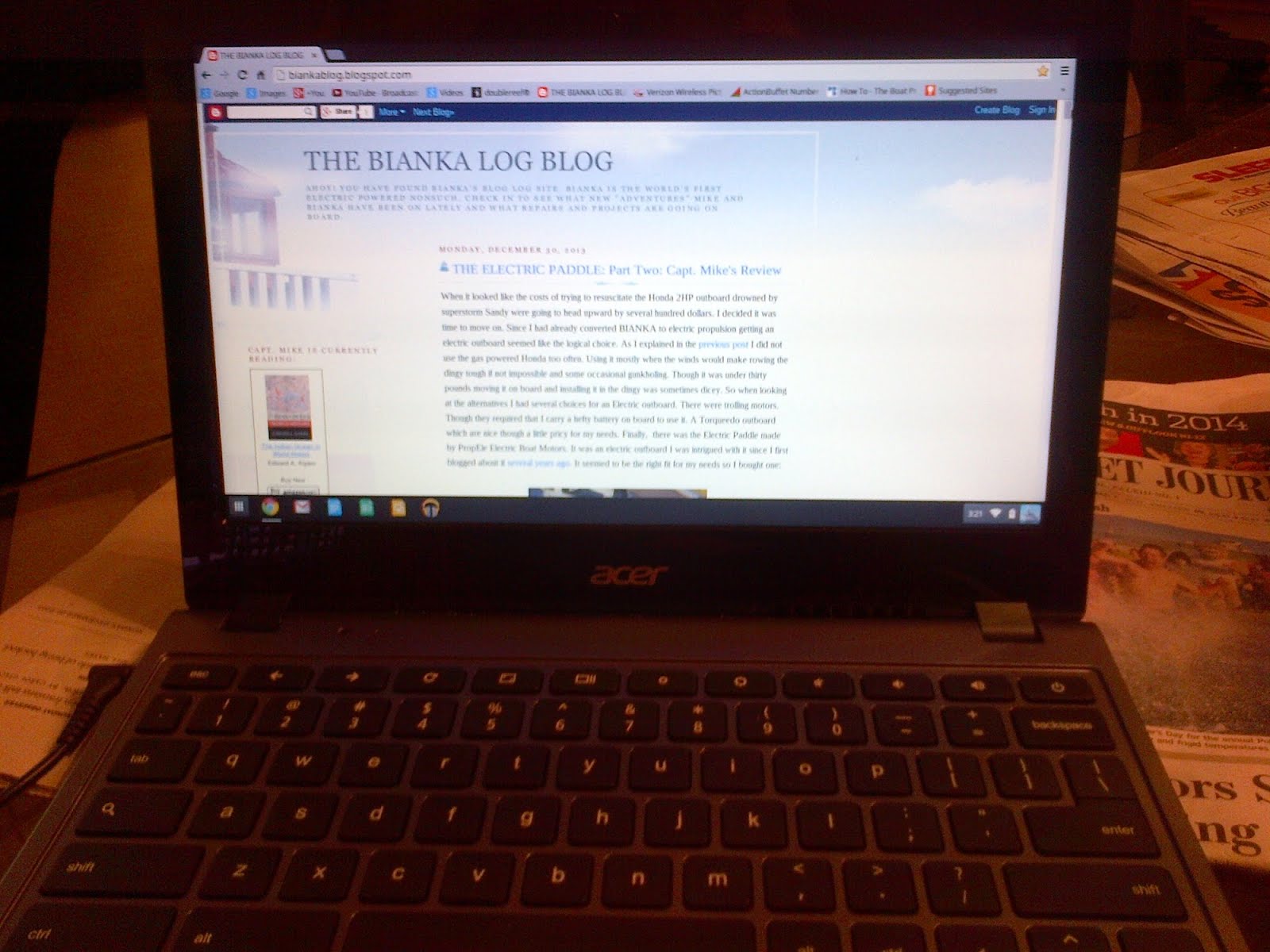
DIGITAL WATERS: Using the ACER C720 Chromebook

I am going to be traveling some place warm soon where my gal and I will be on board a forty five foot Catamaran and spending a part of the winter snorkeling, diving and just basically enjoying the warmth. Just like when I am on BIANKA these cruises unleash the creative juices and I wish I had my laptop with me to do some writing. I've been recently looking at the Google Chromebooks which are basically a light laptop that works primarily through the Internet . Not as full featured as a real desktop or laptop computer and does require access to a wifi connection in order to do a lot of things. But, it does come with a basic word processor and have some on board storage for documents in the solid state memory. It’s light and seems good for traveling. At around only two hundred bucks it seemed like a good thing to have even have as a backup to the laptop. So I bought one.

I choose an Acer C720 Chromebook
Both for price and the mostly favorable reviews. So far I am very happy with it and I’m doing everything I usually do with my laptop including writing this blog post. It boots up fast, much faster than the laptop and so far there have been none of those annoying updates and reboots that Bill Gates and company unleash on the digital world from time to time. So far so good though I have only been using it for about an hour.Acer C720 Chromebook


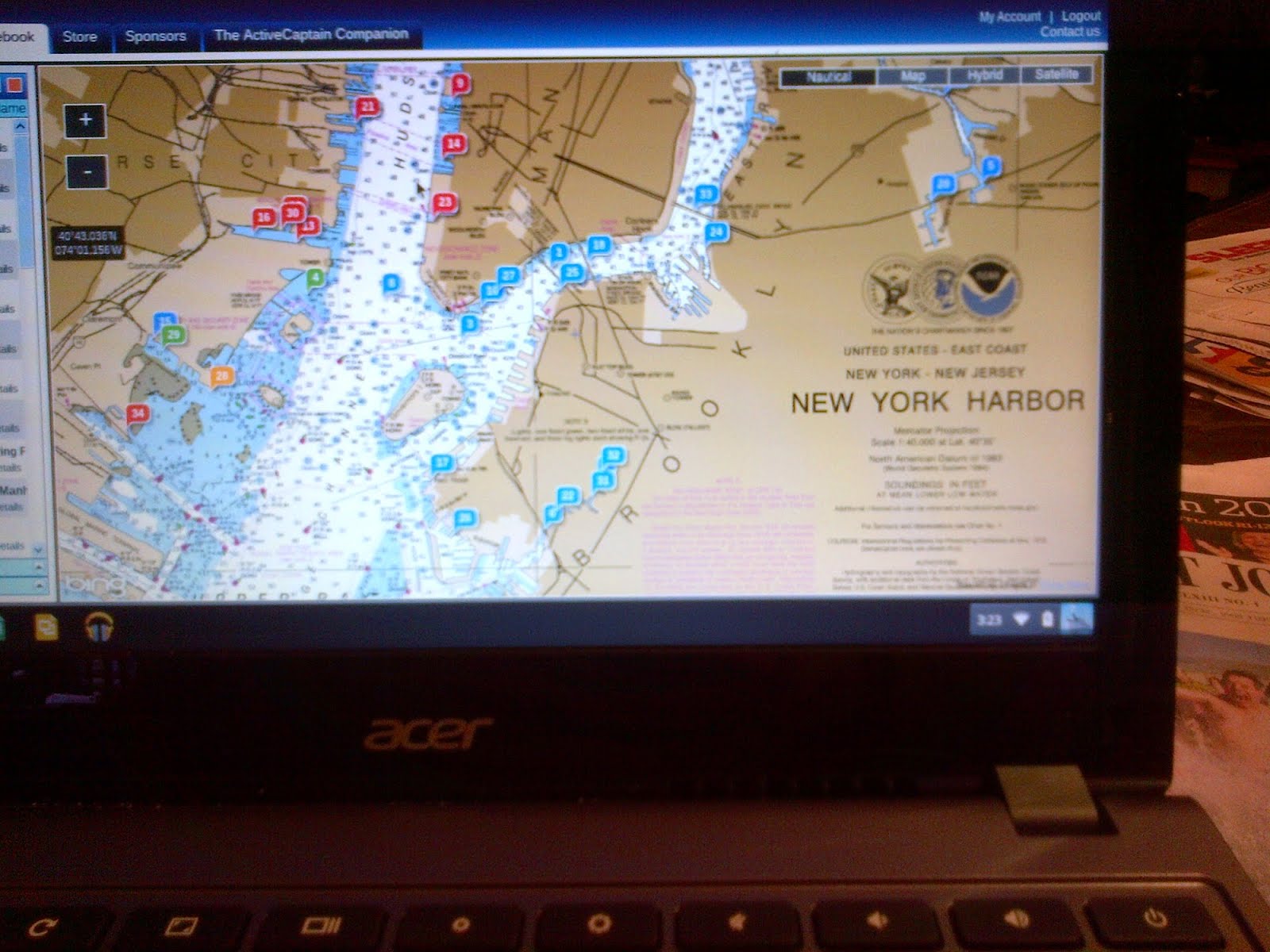
I took the above photo with my cell phone and downloaded it into the Chromebook and it loaded fast and looks as good as my laptop. I also went and checked out Active Captain:


Which is  another site I tend to use a lot when I am on cruising on the boat. Here too access was fast and graphics good. So as long as I have WIFI access which I can create easily with my cell phone acting as a modem. It looks like the Acer C720 Chromebook will work for me both when traveling and when on board BIANKA. I’ll post further remarks as I get to know it better but, the first two hours I’ve been able to make this blog post pretty painlessly. A good sign of things to come.

Friday, January 10, 2014

SONGS FOR SAILORS: High and Dry: Gordon Lightfoot

I went down to the boatyard to do one of my off season checks on the boat and there was BIANKA  high and dry patiently waiting for spring on the jackstands:

As I saw here there a Gordon Lightfoot song popped into my head called High And Dry from the 1970's album called Sundown.  It was an album I use to listen to when I was in High School which was a couple of years before I took up sailing. As the song played in my head I thought yeah this lament for a boat or a girl deserves a spot on my MP3 player:


With a lady-like devotion

She sails the bitter ocean
If it wasn't for lovesick sailors
There'd be nothin' left but flotsam
Singin' why me oh my
Is there a better man than I
I hope you find your way back home
Before you're lyin' high and dry
I hope you find your way back home

Before you die 

Though I'm having trouble deciding between two versions of the song there is the original High And Dry from the Sundown album. Then there is the High And Dry [1988 Version] from Gord's Gold Volume II. I just might have download both versions.


Monday, January 06, 2014

NOTES OF AN ELECTRIC SAILOR: The AIMS 48 Volt 1500 Watt Pure Sine Wave Inverter

After I bought the Electric Paddle outboard some things went away. Such as the need to carry extra oil, gas and parts like zincs, spark plugs etc... for the Honda BF2 outboard.  But, I was faced with another issue on how to charge the Electric Paddle's battery. BIANKA usually stays on a mooring or at anchor so charging from the dock power is not an option.  Since part of my three legged approach to energy on board BIANKA includes a Honda 2000 generator charging the 28 volt battery is a easy but, I really don't like to run the generator if I can avoid it. Running it for an hour or two to just charge the Electric Paddle's battery just seems like a waste of energy. So I started thinking about getting an inverter for the boat. According to the Electric Paddle's manual the 120 volt charger can charge the battery using an inverter of only 200 watts. Though when I thought about it there might be a few other 120 volt items I might like to use on board from time to time without needing to fire up the Honda Generator. Having a 10 kilowatt 48 volt electric propulsion battery


bank does come in handy after it is charged up at anchor. One can easily tap into it from time to time and then  just let the solar panels and wind generator recharge things without ever having to fire up the generator. So it seemed like it was a good idea to spring for a 48 volt to 120 volt sine wave inverter to not only charge the Electric Paddle battery but, also be able to use it for other needs like running the Wet/Dry Micro Vac for quick clean ups, using 120 power tools and maybe a bread maker or microwave down the road. The inverter I decided on was the AIMS PWRI150048S 1500 Watt Pure Sine Wave Power Inverter, 48 Volt. It would easily be able to handle charging the Electric Paddle battery pack and also be powerful enough to use for more powerful AC items.

When I first bought the Thoosa 9000 electric propulsion system for the boat I also purchased a 48 volt to 12 volt converter. It is a 300 watt Sevcon converter. I mostly use it for powering the laptop while at anchor to blog and search the Internet. It works well with the 12 volt power supply I bought for the computer. I've also used it to temporarily power the on board Engel Refrigerator - Freezer when several days of cloudy/rainy weather drained the 12 volt house bank to far. Here is are some photo's comparing the size of the converter and the inverter:


There is a bit of size difference but, the Inverter is five times as powerful and can be used to power more things including the laptop and Engel along with a number of 120 volt devices. Connection of the AIMS Inverter to the 48 volt battery bank is by two terminals on the back of the unit:

The front of the unit has two AC outlets, an on/off switch and two status LED's and a ground lug:


The AIMS Inverter also comes with a handy keychain type rf remote switch so you can mount the unit in a remote location on board but, still turn it on and off when needed without having access to the front panel on/off switch.  For now I have mounted the unit in the main cabin where I can see the status lights and have access to the on/off switch and AC outlets. I am also using the 15 amp tap of the 48 volt Morningstar solar controller to provide power for the inverter via 75 amp Anderson Powerpole connectors:

This means I am limited to only using around 700 watts of the 1500 watt potential on the inverter. But, for now that's all I need. So far the AIMS Inverter has come in very useful primarily for charging the Electric Paddle battery without requiring I run the generator for hours and it will come in even more useful to power other devices in the future.


Friday, January 03, 2014

BOOKS FOR SAILORS: Some winter reads


The low temperature tonight is expected to be 4 degrees fahrenheit here in the northeast U.S. tonight. That's cold and just the night to start reading an interesting tale of two unfortunate crew members of a whaling ship marooned in the Arctic called Cast Away in the Cold An Old Man's Story of a Young Man's Adventures, as Related by Captain John Hardy, Mariner It's a great yarn written by Issac I. Hayes who had been part of the Second Grinnell Expedition to search for John Franklin.  An expedition which became a matter of survival as the expedition's ship Advance became stuck in ice. Three members of the crew died and the others including Hayes embarked on their own epic journey of Arctic survival. Which is why Cast Away in the cold is full of detail that only one who has experienced in the Arctic can provide.

Or if non fiction is more your preference then Arctic Workhorse: The RCMP Schooner St. Roch might suit your fancy. It's the tale of the first boat to successfully travel the Northwest passage and may help you get through some of the cold dark nights of winter too.

Monday, December 30, 2013

THE ELECTRIC PADDLE: Part Two: Capt. Mike's Review

When it looked like the costs of trying to resuscitate the Honda 2HP outboard drowned by superstorm Sandy were going to head upward by several hundred dollars. I decided it was time to move on. Since I had already converted BIANKA to electric propulsion getting an electric outboard seemed like the logical choice. As I explained in the previous post I did not use the gas powered Honda too often. Using it mostly when the winds would make rowing the dingy tough if not impossible and some occasional gunkholing. Though it was under thirty pounds moving it on board and installing it in the dingy was sometimes dicey. So when looking at the alternatives I had several choices for an Electric outboard. There were trolling motors. Though they required that I carry a hefty battery on board to use it. A Torqueedo outboard which are nice though a little pricy for my needs. Finally,  there was the Electric Paddle made by PropEle Electric Boat Motors. It was an electric outboard I was intrigued with it since I first blogged about it several years ago. It seemed to be the right fit for my needs so I bought one:


As you can see it is small enough to fit on the cabin table along with the battery pack, charger and the spares that come with it. It is very light and compact and is much easier to stow under the cockpit without the worry of leaking oil and other fluids. It was about two hundred dollars more than a new Honda BF2 outboard would be. But, there are no oil changes, zincs, lower lube or winterization costs like with the gas powered Honda. It also means I need to carry less gasoline on board. Indeed maintenance seems to only involve dipping the lower unit into a bucket of fresh water and letting it drain.

It's designed for propelling small yacht tenders, rowboats, canoes, kayaks and sailing dinghies less than 9 feet long and under 800 pounds when loaded. So it looked like it would work well with my 8 foot Porta Boat and it does.

Both the Electric Paddle and it's 24 volt battery pack  fit very nice and compact on the transom. The battery pack hangs suspended on the locking handle out of the way and off the bottom of the dingy. There is no concern it will be sliding around if the boat gets hit by a wake. The motor and battery pack each weigh only eight pounds and are much easier to install on the dingy than the 28 pound Honda gas outboard. I am able to hold it in one hand and still have one hand for the boat. I never felt it or me had the possibility of going overboard while trying to attach it to the transom in rough conditions. PropEle also make a 12 volt Electric Paddle without battery or charger too.

It has a magnetic key attached to a lanyard that inserts into the steering handle and stops if it is pulled out. It also has a safety start feature in that the motor will not start unless the throttle is first turn to the off position. So that there is no sudden unplanned forward movement when inserting the key. Another nice thing about electric outboards is unlike small gas outboards you won't knock out your passengers or spouses teeth when pulling the starter cord because there is none. A turn of the throttle and you are moving. Connection between the motor and the battery pack is with a secure waterproof connector:

 I've left the Electric Paddle hooked in the dingy during several rainstorms with no ill effects. I've also inadvertently left the throttle control laying in water in the bottom of the dingy when I tilted the unit up and it has not caused any problem. That's because the design uses waterproof magnetic hall effect sensors for the control.  Adjusting the tilt of the Electric Paddle is very easy as shown in this video:


Note: You don't have to be in the water to make the adjustment. It was just easier to get a good camera angle for the video.

Another nice feature is the ability to slide the shaft and prop up in the bracket when tilting the motor up:

This makes it easier to reach the prop to clear it of weeds. Though the Joe Grez the Industrial Product Designer who designed the Electric Paddle said usually all one has to do it power the prop a second or two once it is out of the water and any debris goes spinning off easily. Speaking of props the Electric Paddle uses a large diameter, high pitch, high aspect prop like those used on propeller airplanes. But, Electric Paddle uses one that is specifically designed to be efficient at lower RPM's needed for pushing a boat through the water.

When using the Electric Paddle I have recorded speed tests of 2.2 miles per hour using the GPS app on my cell phone:

Which is just .1 MPH below the minimum specs the manual says I should be getting. Though playing around with the tilt angle may improve that. I'm still very happy with it's performance.


The Electric Paddle comes with an extra magnetic key, key for the motor lock, spare cotter pin and prop.

Having used the Electric Paddle during this past season I have to admit I'm getting a little spoiled. I've been using it more and rowing less. In part because it is so much easier to carry and install than the old gas outboard. I've used the Electric Paddle outboard more in just this past season than I have the old gas outboard in the past five years. I'm sure I'll be using it more in the future. I don't miss the old outboard at all. It was a gas guzzler and very noisy. The Electric Paddle is quiet enough to be able to have a quick conversation while passing other moored boats without slowing down. Because it is so quiet it makes great for gunkholing and bird watching.  To charge the battery pack requires 120 volts but, it can be charged with an on board inverter that is only 200 watts or larger.

In short if you are use to speeding across the harbor with a 15 HP outboard doing 15 knots in a 12 foot inflatable sitting over the gas tank with a cigarette dangling from your mouth. Then the Electric Paddle is not for you. But, if you need a quiet,reliable, low maintenance,  easy to store and carry electric propulsion system for the dingy to get back and forth to the dock at speeds that won't get you in trouble with the Harbor Police then it might be just the thing. You can also use it on your  Kayak or Canoe too so it's more versatile than the gas outboard too . For my needs the Electric Paddle gets the Capt. Mike thumbs up. It's a welcome addition on board BIANKA. One that I'll be using more than the old gas outboard.


Friday, December 27, 2013

THE ELECTRIC PADDLE: Part One: What's in the box.

When I bought BIANKA in 1995 she had on board a Honda BF 20SA outboard a 2 HP four stroke outboard for use with the dingy.

 I did not use it a lot and most of the time it stayed down below in the cockpit locker. It weighed only 35 pounds and was small enough to fit there though one it was a little awkward to lift out sometimes. The outboards metal fins or handle would sometimes catch on stored lines and other items stored next to it. Since I did not use it all that often it was not a big issue. I mostly rowed the dingy. On occasions when I actually used it I found it noisy (especially after having converting the mother ship to electric propulsion) and a real gas guzzler when compared to the on board Honda 2000 generator I used for charging the electric propulsion system. Still it was nice to have on board and be able to use it when the need arose. Like other Honda products it was pretty reliable so it stayed on board.

At the end of October 2012 I was preparing BIANKA for what would become super storm SANDY. The winds the day before while I was on board preparing for the storm were blowing 20 to 25 knots from the northeast and the dock I needed to bring the dingy back to was located northwest. I was not sure I would be able to row the dingy in the docks direction without first being blown across the harbor. So I decided it would be prudent to bring out the Honda outboard and have it available on the Porta Boat dingy in case the winds prevented me from rowing to my destination.  It turns out I was able to row to the docks crabbing the dingy with just the oars and never needed to fire up the outboard. When I got inside the marina I tied the dingy to one of the docks protected by high bulkhead. I left the motor on the dingy just in case I would need to use  it once the worst of the storm had past to get back to the boat. I thought the dingy would be protected from the worst of the storm but, I was wrong. The dock it was tied to broke apart:

When it broke apart it flipped the dingy and sent the Honda BF 20 outboard to the bottom. I spent a few days with a grapple until I finally snagged it and brought to the surface. A few crabs and small fish had already tried to make a home inside the cover:


I quickly rinsed the outboard in fresh water and sprayed it liberally with WD-40. I spent a number of days over the winter trying to remove one or two screws that had over the years became severely corroded even before Sandy. It took several attempts using  PB Blaster . to remove them. By then the carburetor had signs of severe corrosion. Still I continued on the taking it apart:


 In the spring I started to look at the economics of trying to resurrect the thirteen plus year drowned outboard and decide it might not be worth it on such an old engine. So I started to look for a replacement.

I had done a post about a small electric outboard called The Electric Paddle back in 2011. I was intrigued with it's concept and it seemed like it was really what I needed for my dingy use. But, since I'm a "if it ain't broke don't fix it sailor" and the Honda BF20 was still working for me it did not pass the "want vs need" test. The drowning of the Honda outboard during Sandy changed all that. So earlier this season I decided to buy the Electric Paddle. It did cost more that replacing the Honda outboard but, my experience with converting to electric propulsion on BIANKA and it's low maintenance and high reliability tipped the equation toward buying it. It was also cheaper than other electric outboards like the Torqueedo's. It arrived just a few days after ordering it. It's made in the U.S.A built in the Pacific Northwest by a family run business. When it arrived I took the box on board here's what I found when I opened it up:


In the next post I'll share my experience with using the Electric Paddle.