Wednesday, December 31, 2014

AN AFTERNOON ON THE COLUMBIA RIVER ON AN ELECTRIC SCOW


Well, it's New Years Eve and I'm looking back on some of the years highlights on the water past year. April found me in the Pacific Northwest spending a few days in Portland Oregon. While there I contacted a fellow named Myles Twete who is very involved in Electric Vehicle area and the Electric Boats group on Yahoo. When I converted BIANKA back in 2008  he and others in the group were very helpful with advice and expertise that was not commonly available elsewhere.  I was eager to spend a little time on the water and Myles graciously agreed to show me his twenty six foot Columbia River Scow Reach of Tide built by Sam McKinney . To start things off Myles picked me up in his THINK electric car.  Here's a quick video of some of that day spent on the Columbia River back in April:


It was not a total pleasure cruise. Even though Myles had converted the Tohatsu outboard back in 2006. Being an engineer he was still keeping data it's operation, modifications and charging:

Myles had a movable inductive speed control for the motor that allowed him to operate the motor at the helm position or in the cockpit:
The toggle switch was to put the motor in reverse. BLOG UPDATE: Myles has informed me that the switch actually is the on/off control  for the main power to the controller. Forward and reverse of the outboard is done by the original mechanical shifting of the outboard.


Despite the rain and overcast conditions it was a fine day on the water.

Saturday, December 27, 2014

MAKING YOUR OWN PARTS WHILE CRUISING?

   
While cruising this past year I met a family with a son in high school who had a 3D Printer at home. He made a new sheave for one of the blocks on their boat. While it was not really UV stabilized and it probably would not last as long as the original still, was holding up quite well after year. Pretty impressive. Making ones own small parts to replace broken ones while cruising might be common place at some point in the future if one had a 3D printer on board. I forgot which one he had but, I do notice even major tool companies like Dremel now have products like a Dremel Idea Builder 3D Printer for sale. The ability to make ones own custom parts even if only for a temporarily fix can save a cruise or enhance things on board. While current 3D printers may be somewhat large to carry on board some boats. There is another aspect of 3D printing may show up on land in the near future.  Hardware and marine stores with sophisticated 3D printer will be able to make parts using various materials that are currently unavailable. Even in remote locations. That would also be good thing for cruising sailors.


Wednesday, December 24, 2014

Joshua Slocum Christmas


"The Spray early in the morning passed Twofold Bay and later Cape Bundooro in a smooth sea with land close aboard. The lighthouse on the cape dipped a flag to the Spray's flag, and children on the balconies of a cottage near the shore waved handkerchiefs as she passed by. There were only a few people all told on the shore, but the scene was a happy one. I saw festoons of evergreen in token of Christmas, near at hand. I saluted the merrymakers, wishing them a "Merry Christmas." and could hear them say, "I wish you the same."-Sailing Alone Around the World

Sunday, December 21, 2014

HACKING THE PORTA BOTE

I've been using a folding eight foot Porta Bote for my dingy for over thirteen years now. I'd have a hard time considering using another type of boat. Recently I lost the wooden setup stick that came with the boat. It fell out of the car unbeknownst to me at the time. I could have made up a new one of some 3/4 inch wood. But. looking around the garage I notice I had a bunch of 1-1/2 inch PVC tube laying around. I wondered if it would make a good replacement for the original set up stick?  So I cut one to the approximate size need to open the folding Porta Bote hull. It worked fine.

Plus since it was not wood it could not soak up water and split as my original stick did after several years. Though I repaired it with some epoxy type glue the PVC tube is not prone to water water damage. The only thing was it did not float like the original wooded stick did.  What to do? The answer I came up with was to fill the inside of the PVC pipe with some Great Stuff Gap Filler. This did two things not only did it ensure that the setup stick would float if accidently dropped into the water. It also stiffened the tube quite a bit structurally making it stronger and less likely to crack.

I very pleased with my improved setup stick homemade replacement and it should last longer than the original.

Thursday, December 18, 2014

BUH BYE JETSKIS ?

Interesting new watercraft that might replace noisy gas guzzling Jet Ski's and possibly one's dingy with electric propulsion powered Quadrofoil.

"the average jet ski is powered by a 125 hp motor, and one Kawaski model uses a mind-melting 300 hp, the Quadrofoil is powered by 5 hp (3.5kW), 25 times smaller than the average jet ski. Yet on that mere 5 hp, it can hit speeds up to 40 km/h and, says Pivec, accelerate like a Ferrari. Better yet, once it reaches between 10-12 km/h (6-7.4 mph) and the 'wings' lift it out of the water, its speed suddenly increases, while its power consumption drops by half. Best of all, it dumps no dirty hydrocarbons into the water. And if skimming over the water at 25 mph - and in the process slicing through those wakes and waves - isn't exciting enough for you, Pivec says they are working on faster craft and bigger models: a four-place is on the drawing board. They also have a patent that overcomes one of the drawbacks of conventional hydrofoils: their inability to turn in tight circles. The Quadrofoil has a 7 meter (23 ft) turning radius, made possible by their steerable 'wings' and motor." - EVWORLD


Adoption of electric propulsion should make anchorages a little quieter too! Stay tuned.

Hat Tip: John Rushworth

Wednesday, December 10, 2014

BIG MAMMALS AND THE BIG APPLE

I've been thinking about doing another around Long Island cruise recently. I did one a number of years ago back in the days when I still had a diesel engine on board. It was somewhat of an adventure with the engine exhaust elbow developing a hole the first day requiring some jury rigged repairs. I also lost my crew when he had to leave the boat because of the death of a friend. I ended up heading into Shinecock Inlet for the first time at night by myself in those pre GPS days. Like I said it was a little bit of an adventure but, I got in despite the conditions.
I've been thinking about doing another similar cruise now that I have electric propulsion. There is a lot of traffic in the area from freighters, cruise ships, tugs and barges and a lot of fishing boats. So one needs to be alert. Then there was this kind of a good news/bad news story that is making people stand up and take notice:

"Humpback whales, the gigantic, endangered mammals known for their haunting underwater songs, have been approaching New York City in greater numbers than even old salts can remember. Naturalists aboard whale-watching boats have seen humpbacks in the Atlantic Ocean within a mile of the Rockaway peninsula, part of New York's borough of Queens, within sight of Manhattan's skyscrapers.
"It is truly remarkable, within miles of the Empire State Building, to have one of the largest and most charismatic species ever to be on this planet," said Howard Rosenbaum, director of the Ocean Giants program at the Wildlife Conservation Society.
Humpbacks were spotted 87 times from the boats this year, and by cataloging the whales' markings, at least 19 different humpbacks have been identified in the waters off the city."- ABC News

As I said it's a good news bad news story as far as my plans go. While it's nice that the whales are returning to the local waters here. It does add a little more apprehension when cruising the ocean waters in a 30 foot fiberglass boat. Namely that one of them might perceive BIANKA sailing along in the middle of the night as a threat. I know the risk is probably low but, it's just another thing one has to think about and prepare for these days.


Wednesday, December 03, 2014

A LOOK AT THE XS SCUBA GOPRO MASK

I have a GoPro camera that I use on board BIANKA and when chartering on other boats. Though my homemade floating handle requires I use one hand to hold it when taking videos or stills. While I was looking around for a new dive mask this summer I came upon the XS SCUBA GoPro MASK . This mask has a metal bracket where one mounts the underwater housing of a GoPro camera when snorkeling or diving.
Seemed like a good item to have on board. Though my local waters are rather nutrient rich and visibilty is limited. I do get to spend a lot of time in waters of the Caribbean and elsewhere around the world where visibility is much clearer and the mask would be more useful. So I bought it and here is a quick look and test on how it works:


I'm pleased with the mask and will get to try it out in clearer warmer waters soon. If you know someone who has a GoPro or similar camera like the Swann Freestyle Waterproof Video Camera  it would make a great gift too!

Saturday, November 29, 2014

IN BIANKA'S GALLEY:Zojirushi BB-HAC10 Home Bakery 1-Pound-Loaf Programmable Mini Breadmaker

Adding the 48 volt inverter to BIANKA opens up new choices for items that enhance cruising on board. One of the simple pleasures I enjoy is a nice sandwich for lunch in the cockpit. Though having bread on board can be problematic.  On one hand some of the store bought bread seems to last an unnaturally long time due to the preservatives it is made with. On the other fresh store bought bread does not last that long before it needs to be thrown out. In both  cases the bread eventually gets moldy and requires a trip back to land to replenish the galley with more. That's why I bit the bullet and bought a Zojirushi BB-HAC10 Home Bakery 1-Pound-Loaf Programmable Mini Breadmaker. It is more expensive than some of the larger capacity breadmakers one can buy in the big box stores. But, it's small size really makes it more useful on board a 30 foot boat of this single sailor. So that was a major consideration for me. First let's take a look at what comes with the Zorirushi:


With the Ames 48 volt inverter using the Zoriushi is pretty simple. It's small size allows it to easily fit somewhere on the counter as it makes fresh bread. As shown here on BIANKA's slide out surface over the stove:

It has a much smaller footprint and the built in handle makes it much easier to move into storage than the bigger two pound bread makers. It also has a convenient clip on the back to store the power cord:

The clip helps when putting the unit into a locker for storage.  Now to move on to the bread making test. I first made sure the 48 volt battery bank was fully charged and the XBM battery monitor was reset to 100%:
I

The bread maker comes with a large instruction manual and also a DVD for the various recipes. But, it also has a decal on the side with the procedure and ingredient list for the basic bread recipe: 


This comes in handy as one does not need to always refer to the written manual just to use the basic bread recipe. After adding the ingredients in the order selected I hit the start button. The unit seemed to just sit there for twenty minutes with the words "Rest" on it's LCD screen:

At first I thought this strange. What is really going on is the Zojirushi  is heating up the container and the liquid ingredients to the proper temperature before mixing  them with the dry ingredients. Handy since one does not need to preheat the water like on some of the other bread makers. The unit goes through several cycles in the three hour and 40 minutes it takes to make a one pound loaf of fresh bread. There is the mixing/kneading cycle:

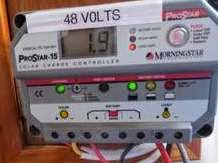
Looking at the amp draw from the 48 volt battery bank shows a 1.9 amp draw:

During the rising cycle there is minimal current as the dough is allowed to rise:

It is during the baking cycle where it has it's highest current draw of about nine and a half amps:


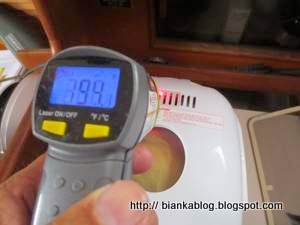
Though this is not constant amp draw but, cycles depending on the heat of the baking chamber. Speaking of heat the top of the unit does get quite warm 196 degrees Fahrenheit when measured directly at the vent:

Though the top of the unit is about 50 degrees cooler. Still it's best to keep inquisitive hands away from the unit during baking. After three hours and forty minutes the bread is finished:


In between the cabin has has been filled with the aroma of fresh baked bread. After it was finished baking the bread I took a look at the XBM battery monitor:


Which shows the loaf used about 2.2% of the battery capacity. Which quite easily made up with the solar panels and/or wind turbine. 

Checking on other parameters the XBM showed the Zojirushi only used 4.6 amp hours from the 48 volt battery bank. A small amount to expend in order to have fresh bread available on board. I have found that a loaf will last me three or four days including having toast in the morning and a sandwich in the afternoon. I am very pleased with the Zojirushi unit.  It also seems to be better built and quieter than the cheaper bread makers. It's compact size makes it ideal for a boat with limited storage space. But, best of all as a sailor who tends to cruise having the ability to make fresh bread also limits the need to head back to shore to re-provision. I can stay in the cockpit enjoying lunch thinking about  the parting words of the late Warren Zevon which were to "enjoy every sandwich".

Wednesday, November 26, 2014

SAILORS THANKSGIVING


What's that sound? It's a Gravy Boat coming around.

Wednesday, November 19, 2014

ANOTHER LOOK AT REGEN

I installed electric propulsion in BIANKA for several reasons. One was because my diesel engine died. Two because I spent a good amount trying to get it running again. I began looking at alternatives to having a diesel. Diesel works well where it is worked hard. On a sailboat where most people use the engine to primarily get into or out of the harbor is not the best way to use it. Installed on a trawler is a much better match. So diesels tend to rust out before they wear out or fail at some point when you least expect it. Hopefully in some location  where you can get help and parts.  Another thing about electric propulsion is the ability of it to regen i.e. recharge the battery bank when the boat reaches a certain speed under sail. I thought for the first few years  that my system was not capable of regen but, then one day I discovered that it did. Hybrid Marine has a nice video of how regen works.  The boat in question is a hybrid design and still has a diesel engine. Which would mean the engine might be used even less than in a normal engine setup. But, you still have all the maintenance issues involved with having a diesel installed. But, for those not quite ready to make the leap to a pure electric propulsion system it is an option. Anyway this video is a good primer on the regen aspects of electric propulsion. Hat tip Elektra Yachts: